Tuesday, 26 November 2013

Different Training Methods for Running (Part 1)

A few years ago I met a guy in his first year of university. He was really strong and muscular. We talked about his training and he complained about how difficult it was to select a program. “Everybody is giving different advice,” he said. But, what he didn’t realize is that all successful programs have common themes; there are many workouts and systems that appear different on paper, but have the same effect. In this series of posts I’d like to discuss different workouts and periodization schemes for achieving improved performance in running. If you’re willing to study the underlying physiology or “waste” your time performing every program out there as I have you’ll discover similarities.

I’ve tried to simplify things by dropping the workouts into buckets without using scientific terminology; you could easily create your own categories based on pace or percentage of VO2max.

Important Note: I’ve given example workouts, but in order to be brief I wasn’t able to give examples for every fitness level. Therefore, these workouts may need to be heavily modified for your situation. Focus more on the description while using the examples as comparison to the other sessions.

Peter Snell defeating pre-race favourite Roger Moens in the 1960 Olympic 800 m.

Specific Training

I’ll start with event specific training and shoot off in either direction. The goal of event specific training is simply to replicate the demands of the race. This may be in the form of developing the energy systems or simply training at the speed of the race. Depending on your abilities and goals you may pick all of these options or just a couple.

Option 1: Race the event distance. This was a very popular means of training back in the 70s and 80s. By racing nearly every week runners required very little event specific training. However, the longer the event the less successful this method becomes. There are very few if any runners that are capable of running at their best for more than 2-3 marathons on an annual basis.

Option 2: Time-Trials of equal or shorter distance. While running the event distance replicates the race distance, running a shorter distance allows one to run at goal pace.

Option 3: Long Intervals with Full Recovery. These sessions are very difficult, so they’re only done a couple times a year and should not be done by young or inexperienced runners. Each interval will feel like a maximum effort during a hard training week, so don’t hesitate to take more rest.
            800m: 2-3x600m with 10-15min rest
            1500m: 2-3x1000m with 8-12min rest
            5km: 2-3x2000m with 8-12min rest
            10km: 3x3000m with 3-5min rest

Option 4: Medium Intervals with Short Recovery. These sessions can be done once a week in the latter training phases.
            800m: 5x400m with 4min rest
            1500m: 4-6x600m with 3min rest
            5km: 5-6x1000m with 90sec rest
            10km: 5-6x1mi with 90sec rest
            HM: 5-6x3000m with 3min rest
            Marathon: 3x10km with 1km jog rest

Option 5: Short Intervals with Short Recovery. These are moderately demanding sessions, so they can be done fairly frequently or as progressions to the other interval sessions.
            800m: 3x5x200m with 30-60sec between intervals and 5min between sets
            1500m: 3x5x300m with 45-60sec between intervals and 5min between sets
            5km: 15-20x400m with 30-60sec
            10km: 15-20x500m with 30sec rest

Option 6: Short Intervals with Long Recovery. These sessions are very easy and can be done in all phases of training. The goal is on biomechanics rather than energy system development.
            800m: 6-10x200m with 2min rest
            1500m: 6-12x300m with 90sec-2min rest
            5km: 12-16x400m with 90sec rest
            10km: 12-16x500m with 90sec rest

Option 7: Continuous Run
            HM: 10km Easy + 10km at Race Pace
            Marathon: 10mi Easy + 10mi at Race Pace
           
Option 8: Surging. These sessions are reserved for runners looking to qualify for championship finals and contend for medals. Sessions and sets within sessions are started at/slower than race pace and then the pace is kicked up a notch on subsequent intervals.
            800m: 3x(300, 200, 100m) with 90sec between intervals and 3min between sets
            1500m: 3x(400, 300, 200m) with 90sec between intervals and 3min between sets
            5km: 4x(1000m + 200m) with 60sec between intervals and 3min between sets
            10km: 4-5x(1600m + 400m) with 60sec between intervals and 3min between sets
            HM: 4x(2km + 1km) with 60sec between intervals and 3min between sets
            Marathon: 25km with 1km surges every 5km

This is far from an exhaustive list. All the rest sections in the above examples are passive, but one could use a jog recovery and extend the rest sections or subtract volume from the workout. Also, in most cases I used intervals of the same length at the same pace, but it’s boring to do 10-20 of anything. I love doing workouts like 2x6min at 10km pace, 2x4min at 5km pace, 2x2min at 3km pace with 2min rests.


In the next piece, I’ll discuss how to develop general conditioning in order to handle higher volumes of specific training. 

Stay fit,

Jonathan Pratt
Pratt's Pro Fitness

Monday, 4 November 2013

A Balanced Take on the Stretching Debate

Recently on Letsrun.com a poster started a thread claiming that “All Stretching Is A Waste Of Time.” Many posters agreed or partially agreed with this claim citing scientific research. Others disagreed with the claim and backed it up with stories of how stretching worked for them. I think we can learn from both sides to improve movement quality, reduce the risk of injury, and improve sports performance.

If you would like to read what science has to say about stretching for yourself you can read the 73 summaries of warm-up science posted here.

Types of Stretching

There are many types of stretching, but here is a list of the most commonly used techniques:

Static Stretching: Holding the stretch position for anywhere between 10 s and many minutes. Unless otherwise stated “stretching” will refer to static stretching throughout the rest of this piece.
Dynamic Stretching: “Controlled movement through the active range of motion” (Fletcher and Jones, 2004)
Active Isolated Stretching (AIS): Holding the stretch position for no more than 2 s while simultaneously contracting the muscle’s antagonist. Perform multiple repetitions. AIS can be thought of as a type of dynamic stretching.
Proprioceptive Neuromuscular Facilitation (PNF): Contract a muscle for several seconds while it’s in a stretched state, relax, move deeper into the stretch, and repeat

Stretching As Part of the Warm-Up

It seems that the initial negativity towards stretching comes from research showing that stretching during the warm-up led to decreased performance. Studies show a 3-30 % reduction in power output! Behm and colleagues (2004) showed that stretching led to a 9.2 % reduction in balance and a 5.8 % reduction in reaction time. Nelson and colleagues (2005) also showed that stretching impaired muscular endurance. Similar findings have been shown for PNF.

On the other hand dynamic stretching has routinely been shown to improve subsequent performance. According to Fundamentals of High School Strength and Conditioning 2nd Ed. (Brooks and Colleagues, 2012) dynamic stretching has been shown to “improve performance in 20 m sprints, jumping tasks, and agility tests; increase dynamic range of motion; and reduce injury rates when compared with static stretching programs.” Therefore, it would appear that stretching should not appear during the warm-up.

Looking a little bit closer at the research reveals some issues with methodology. The methodology doesn’t follow the advice given by coaches. Firstly, the stretches are held for too long – up to 30 min per muscle group! Most coaches recommend 15-30 s stretches during the warm-up. Secondly, stretching is used as the sole method of warming up. However, when coaches employ stretching in the warm-up it may be preceded by 5-10min of aerobic work and followed by dynamic stretching; it’s always concluded with sports-specific drills.

Interestingly, there’s some research in the link I provided showing that stretching for 15-30 s improves flexibility to the same degree as 45-60 s stretches, but without the subsequent decrease in performance. The link also has research that shows that any decrease in performance from stretching can be reversed with a sports-specific warm-up.

Stretching for Injury Prevention

Contrary to popular belief stretching does not prevent injury … according to the research. However, stretching seems to be employed effectively by many individuals and physical therapists.

The problem with science as it pertains to this particular topic is that science reports averages and standards of deviation. What the science is reporting is that stretching does not prevent injuries for the majority of people using a generalized stretching protocol.

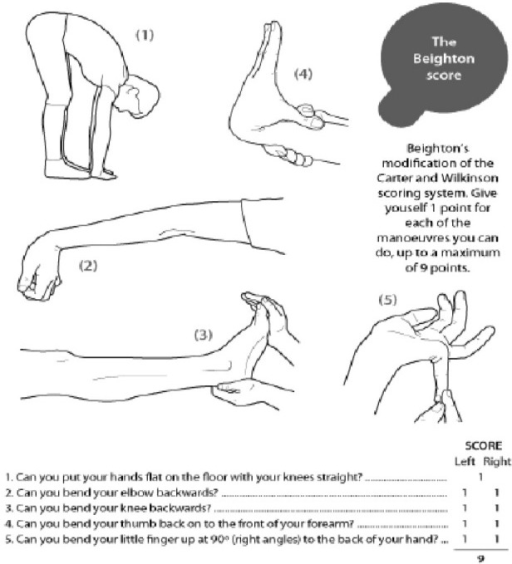
A good coach or physical therapist knows how to manipulate stretching for the needs of his clients/athletes. For example, an individual that’s hypermobile has too much range of motion and is unable to control her full range of motion. Stretching would thus make her more vulnerable to injury. She needs lots of stability work. Similarly, the low back often has adequate range of motion, so most people – including those with low back pain – would be better off to avoid stretching the low back and instead improve range of motion about the hips while working on core stability. Also, avoid stretching the neck as it’s a sensitive area. Leave the low back and neck to chiropractors and other health care professionals.

Your Beighton score determines hypermobility

Another example of a coach manipulating stretching for the needs of an individual is with myself. When I first began stretching my hip flexors my low back pain went away. If I don’t stretch my pectoral muscles before bed I wake up with pain in my upper back. On the other hand, stretching my hamstrings because they were always sore and I couldn’t touch my toes was a bad idea. My hamstrings were always sore because my glutes were weak and I couldn’t touch my toes because I was lacking stability elsewhere.

Gymnasts are incredibly flexible, but many lack the stability to perform a deep squat.

Stretching Recommendations

1. Start with foam rolling to improve the outcome of your stretching
2. If you have time to stretch before exercise stretch problem areas for 20 s. If you haven’t been assessed         it’s a safe bet to stretch the pecs, lats, hip flexors, calves, quads, adductors, and hip external rotators. I        don’t include it in my warm-up process, but I don’t have an issue with anyone that does. I prefer active          isolated stretching instead.
      3. Perform optional aerobic warmup either before or after stretching
      4. Perform mobility (dynamic flexibility) and stability exercises. If you’ve gained range of motion you need to     be able to control that range of motion with stability exercises.
      5. Perform task-specific drills
      6. Train or compete
      7. Follow up with more foam rolling and stretching. I prefer to stretch right before bed as it helps me unwind.

In conclusion, stretching can be used to improve movement quality, reduce the risk of injury, and improve sports performance. Stretching is neither good nor bad; it depends on who’s using it, how he’s using it, and when he’s using it.

Stay fit,

Jonathan Pratt