Recently
on Letsrun.com a poster started a thread claiming that “All Stretching Is A Waste Of Time.” Many posters agreed or partially agreed with this claim citing
scientific research. Others disagreed with the claim and backed it up with
stories of how stretching worked for them. I think we can learn from both sides
to improve movement quality, reduce the risk of injury, and improve sports
performance.
If
you would like to read what science has to say about stretching for yourself
you can read the 73 summaries of warm-up science posted here.
Types of Stretching
There
are many types of stretching, but here is a list of the most commonly used
techniques:
Static
Stretching: Holding the stretch position for anywhere between 10 s and many
minutes. Unless otherwise stated “stretching” will refer to static stretching
throughout the rest of this piece.
Dynamic
Stretching: “Controlled movement through the active range of motion” (Fletcher
and Jones, 2004)
Active
Isolated Stretching (AIS): Holding the stretch position for no more than 2 s
while simultaneously contracting the muscle’s antagonist. Perform multiple
repetitions. AIS can be thought of as a type of dynamic stretching.
Proprioceptive
Neuromuscular Facilitation (PNF): Contract a muscle for several seconds while
it’s in a stretched state, relax, move deeper into the stretch, and repeat
Stretching As Part of the Warm-Up
It
seems that the initial negativity towards stretching comes from research
showing that stretching during the warm-up led to decreased performance. Studies
show a 3-30 % reduction in power output! Behm and colleagues (2004) showed that
stretching led to a 9.2 % reduction in balance and a 5.8 % reduction in reaction
time. Nelson and colleagues (2005) also showed that stretching impaired muscular
endurance. Similar findings have been shown for PNF.
On
the other hand dynamic stretching has routinely been shown to improve subsequent
performance. According to Fundamentals of
High School Strength and Conditioning 2nd Ed. (Brooks and Colleagues,
2012) dynamic stretching has been shown to “improve performance in 20 m
sprints, jumping tasks, and agility tests; increase dynamic range of motion;
and reduce injury rates when compared with static stretching programs.”
Therefore, it would appear that stretching should not appear during the
warm-up.
Looking
a little bit closer at the research reveals some issues with methodology. The
methodology doesn’t follow the advice given by coaches. Firstly, the stretches
are held for too long – up to 30 min per muscle group! Most coaches recommend
15-30 s stretches during the warm-up. Secondly, stretching is used as the sole
method of warming up. However, when coaches employ stretching in the warm-up it
may be preceded by 5-10min of aerobic work and followed by dynamic stretching; it’s
always concluded with sports-specific drills.
Interestingly,
there’s some research in the link I provided showing that stretching for 15-30
s improves flexibility to the same degree as 45-60 s stretches, but without the
subsequent decrease in performance. The link also has research that shows that
any decrease in performance from stretching can be reversed with a
sports-specific warm-up.
Stretching for Injury Prevention
Contrary
to popular belief stretching does not prevent injury … according to the
research. However, stretching seems to be employed effectively by many
individuals and physical therapists.
The
problem with science as it pertains to this particular topic is that science
reports averages and standards of deviation. What the science is reporting is
that stretching does not prevent injuries for the majority of people using a generalized
stretching protocol.
A
good coach or physical therapist knows how to manipulate stretching for the
needs of his clients/athletes. For example, an individual that’s hypermobile
has too much range of motion and is unable to control her full range of motion.
Stretching would thus make her more vulnerable to injury. She needs lots of
stability work. Similarly, the low back often has adequate range of motion, so
most people – including those with low back pain – would be better off to avoid
stretching the low back and instead improve range of motion about the hips
while working on core stability. Also, avoid stretching the neck as it’s a
sensitive area. Leave the low back and neck to chiropractors and other health
care professionals.
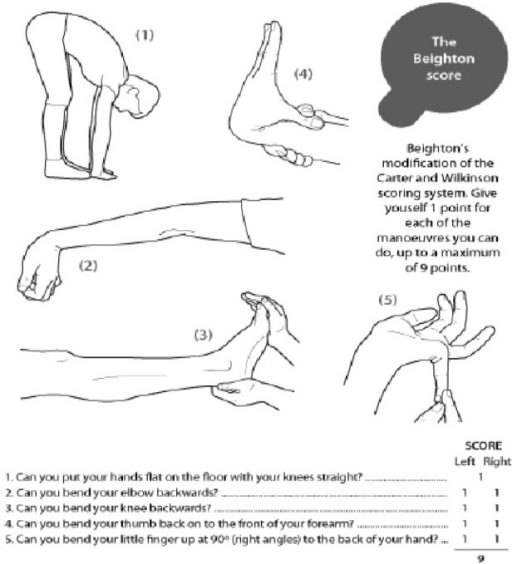
Your Beighton score determines hypermobility
Another
example of a coach manipulating stretching for the needs of an individual is
with myself. When I first began stretching my hip flexors my low back pain went
away. If I don’t stretch my pectoral muscles before bed I wake up with pain in
my upper back. On the other hand, stretching my hamstrings because they were
always sore and I couldn’t touch my toes was a bad idea. My hamstrings were
always sore because my glutes were weak and I couldn’t touch my toes because I
was lacking stability elsewhere.

Gymnasts are incredibly flexible, but many lack the stability to perform a deep squat.
Stretching Recommendations
1. Start
with foam rolling to improve the outcome of your stretching
2. If
you have time to stretch before exercise stretch problem areas for 20 s. If you
haven’t been assessed it’s a safe bet to stretch the pecs, lats, hip flexors,
calves, quads, adductors, and hip external rotators. I don’t include it in my warm-up process, but I don’t have an issue with anyone
that does. I prefer active isolated stretching instead.
3. Perform
optional aerobic warmup either before or after stretching
4. Perform
mobility (dynamic flexibility) and stability exercises. If you’ve gained range
of motion you need to be able to control that range of motion with stability
exercises.
5. Perform
task-specific drills
6. Train
or compete
7. Follow
up with more foam rolling and stretching. I prefer to stretch right before bed
as it helps me unwind.
In
conclusion, stretching can be used to improve movement quality, reduce the risk
of injury, and improve sports performance. Stretching is neither good nor bad;
it depends on who’s using it, how he’s using it, and when he’s using it.
Stay fit,
Jonathan Pratt

No comments:
Post a Comment