I’ve
always been known to have poor flexibility. When I was a kid my mother heard
that many kids were unable to touch their toes. She thought, “There’s no way
that my kids can’t do it.” Sure enough I couldn’t touch my toes. Thus, over the
years I’ve made numerous concerted efforts at increasing my flexibility.
Sometimes I was successful and other times I wasn’t. In fact, one I spent an
entire summer stretching my shoulders only to have no improvement in
flexibility. That’s because flexibility training is more than static stretching.
While I didn’t always see gains in flexibility, I saw other positive changes
such as improved function of certain muscles and the elimination of pain.
The
scientific research hasn’t been particularly kind to stretching. The research
tells us that “too much flexibility may limit performance and increase the risk
of injury” (Joyce and Lewindon, 2014). Still, injury rehabilitation experts
have been successfully using stretching in their treatment protocols for years.
For a more thorough piece on the use of stretching for performance and injury
prevention please read my article A Balanced Take on Stretching Debate.
I recently started stretching again after reading High Performance Training for Sports. The flexibility training chapter which was written by Sue Falsone exposed me to some new research. Although static stretching reduces performance in the short-term, in the long-term it increases the isometric strength and contraction speed of a muscle both of which are useful to athletic performance (Joyce and Lewindon, 2014).

If you train team sport athletes you need to read this book!
This
time my stretching regimen was a lot different. I decided to focus on one
muscle at a time, so that I wouldn’t give up after a few weeks due to
insufficient time. I also added several other techniques to increase my
flexibility: breathing drills, soft tissue work, strength of the muscle at its
end range of flexibility, and strength of the opposing muscle groups.
The
first muscle I worked on was the rectus femoris – a muscle that extends the
knee and flexes the hip. I have previously tested this muscle to be short with
the Modified Thomas Test.
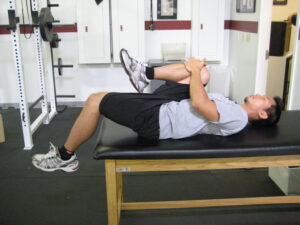

This is what my Thomas Test looked like. My leg now comes down to the table.
The
Postural Restoration Institute tells us that posture affects muscle tone and
breathing affects posture. In fact, the diaphragm is important for posture and
motor control as well as for breathing (Courtney, 2009). Breathing drills alone
have improved my flexibility. So, I would start every session with deep diaphragmatic
breathing with my spine in a neutral position for 5-10 breaths.
This drill is effective for reducing anterior pelvic tilt.
Next
I alternated between foam rolling and stretching. We don’t know why foam
rolling – or massage therapy for that matter – works, but it does. Interestingly,
we now know that stretching doesn’t increase the length of the muscle but
rather improves flexibility by modifying sensation (Weppler and Magnusson,
2010). According to a recent study by Mohr and Colleagues (2014) combining
stretching and foam rolling has an additive effect on flexibility. I foam
rolled the muscle for 60sec and then stretched it for 60sec performing each for
three rounds.
The
third part of the session involved a technique called proprioceptive
neuromuscular facilitation or PNF for short. From a stretched position I
contracted the stretched muscle for 5sec, relaxed, moved into the newfound
range of motion, and repeated until I couldn’t comfortably stretch any farther.
At that point I contracted the muscle’s antagonists: the gluteus maximus and
hamstrings.
Finally,
I concluded the session by performing a strength exercise for the glutes into
the new range of motion. I performed 10 glute bridges. Developing strength and
control in end-range positions is necessary to maintain flexibility and prevent
injuries. The combination of these four techniques has given me normal hip
extension range of motion. Following this experiment, I was able to restore
shoulder flexion.
Improving
flexibility can help or hurt an individual in terms of athletic performance and
injury prevention. When increased flexibility is needed, it may be necessary to
combine a variety of protocols and it’s important to be able to control this
newfound range of motion.
Stay fit,
Jonathan Pratt

No comments:
Post a Comment