What Does Training
for Performance, Health, and Body Composition All Have In Common?
A Quick Look at
What I Do at Pratt’s Pro Fitness
My Story
I
began my fitness journey with lifting weights in the seventh grade so as not to
be bullied. Then, in the eighth grade, I found out I was a good runner and it
was something I enjoyed. During my first couple of years I had no little or no
coaching and even though I competed in high school cross country and track I
trained on my own for much of the year. This is how I learned: through
self-experimentation and many mistakes. I ran a lot faster, but I had developed
periodic pain in my knees, shins, low back, feet, Achilles tendons, left ankle,
and right shoulder. I studied long and hard just to stay in the game and this
led to me eliminating most of these issues. From these experiences, I’ve
developed a system based around staying in the game. Ask yourself this,
“Wouldn’t it be easier to achieve your fitness goals if you weren’t constantly
broken down?”
This
article is for anyone who may be interested in training at Pratt’s Pro Fitness
as well as for current clients. By reading this article you’ll develop a better
understanding of the work I do here and learn answers to some frequently asked
questions. You may even choose to use it to improve the program you use at your
gym.
Summary
Everyone
here trains like an athlete. My clients work hard but nothing we do is
considered hardcore; instead of trying to make you puke or develop crippling soreness
I believe in gradual overload. I wouldn’t consider anything I do to be cool nor
do I do things because they’re trendy. I simply stick to what works based on my
observations and what’s supported by research.
Functional Movement Screen
Movement
is the foundation of every program I write whether your goals are athletic
development, improved function, or fat loss. I use the Functional Movement
Screen and other tests to gain a greater understanding of your strengths and
weaknesses, identify any pre-existing pain, and determine exercise selection.
Not only has the information from the FMS helped me eliminate my own injuries,
but I’ve also helped clients eliminate chronic low back, knee, hip, and
shoulder pain.
 |
| The Functional Movement Screen is a simple way to measure movement quality and aid in exercise prescription. |
Periodization
Periodization
simply means doing the right thing at the right time. There are no random
workouts or exercises. By making changes to your program every few weeks you
can make faster gains, decrease your risk of injury, and reduce boredom. On the
other hand, it’s possible to switch it up too frequently and see poor results.
My training phases usually last 4 weeks. Instead of making a complete overhaul
every 4 weeks it’s best to make small modifications such as changing the sets
and reps scheme or using a different variation of the same exercise.
Sample
Athlete Periodization
Phase 1: Anatomical Adaptation –
Preparation for later phases
Phase 2: Maximum Strength – Stronger
athletes can develop greater power
Phase 3: Power – Power is the key to
sprinting, agility, and jumping
Phase 4: In-Season
Strength/Power – Strength and power must be built during the competitive season
albeit with a greater emphasis on recovery for competition
Sample
Fitness and Fat Loss Periodization
Phase 1: Accumulation – High volume
develops joint health and builds/maintains muscle
Phase 2: Intensification – Heavier
weights develop strength
Phase 3: Accumulation
Phase 4: Intensification
Workout Overview
Workouts
generally take 60 min as shown below, but some individuals need more or less
time to complete an appropriate workload. In a one-on-one setting this workout
can be completed in 45 min.
All
my clients train like athletes although there’s great contrast in programs
based on ability. Thus, programs tend to be similar but it’s rare to find two
that are identical even among clients who are matched up by age, gender, and
goals. At this point you might point out that you’re no athlete. But, how would
you feel if you had an athlete’s pain-free quality of movement or trim figure?
Sample
60min Workout
5min
Foam Rolling
15min
Warm-Up
10min
Power
Perform
3x
Lower Body Power
Upper Body Power
Loaded Carry
30min
Strength
Perform 3x
Hip Dominant
Upper Body Push
Core
Mobility/Stability
Perform 3x
Knee Dominant
Upper Body Pull
Core
Mobility/Stability
Foam Rolling
Foam
rolling is a type of self-massage. It allows us to get more out of the mobility
work that follows and reduces soreness from previous workouts. I’ve found foam
rolling to be a game changer. When I’m running a lot, I can barely move first
thing in the morning without it. A lot of pain tends to be referred pain from
overworked muscles too.
 |
| A couple OFSAA medalists and a national team member foam rolling at PPF. |
Warm-Up
A
proper warm-up enhances performance on your workout and reduces the risk of
injury. Instead of holding our stretches for 30 s (i.e. static stretching), we
prepare for strenuous exercise by gaining range of motion through movement
based stretching (i.e. dynamic stretching). While a proper warm-up can easily
be done in 10 min I extend the warm-up with injury prevention exercises.
Commonly tight muscles are stretched while commonly weak muscles are
strengthened. These exercises are most effective in the long term rather than
for the workout that follows. I began doing this type of work with my high
school cross country team this year daily and it was the first time no one developed
shin splints or needed to take a day off due to something hurting.
I
even spend a minute on your breathing. Proper breathing alters muscle tone
throughout the body. I had an intern perform one drill for five breaths and
when she got up her back pain was gone and her shoulder mobility had improved!
The
warm-up concludes with exercises that prepare you specifically for the workout
such as lunges, squats, and agility ladder work.
Power Training
Power
is a key quality for athletic performance. For health purposes, power is lost faster
than strength as one ages but is important for aiding in fall prevention and
going up stairs. I like to develop power for athletes using plyometrics and
Olympic lifting. Those who are trying to improve health or lose body fat don’t
need such extreme exercises and are better served by performing kettlebell
swings and running through the agility ladder.
Resistance Training
Resistance
training is an umbrella term for training to develop strength, power, and
muscle growth (i.e. hypertrophy). All programs at PPF involve lifting moderate
to heavy weights, although your current level of fitness may require you to
begin with learning to control your own bodyweight or to have your bodyweight
supported.
Athletic
Performance: Resistance training has been shown to improve power, speed, speed
endurance, vertical jump, agility, and endurance and reduce the risk of
developing injuries.
Fat Loss: All
exercise is beneficial for fat loss, but if you have limited time lifting moderate
to heavy weight is more effective at reducing body fat than cardiovascular training.
Resistance training elevates resting caloric expenditure and helps you maintain
your muscle mass while in a caloric deficit. More muscle means more calories
burned. One of my clients lost over 50 lbs this year through resistance
training twice a week and dieting. There was no cardio work and walking was
done irregularly.
Health: Resistance
training reduces body fat, improves your ability to perform basic tasks,
reduces the risk of developing osteoporosis, and reduces age-related muscle
loss.
Circuit Training
Pairing
exercises or grouping several exercises into circuits allows you to get more
work done in less time. I program the circuits to take roughly 5 min and group
together non-competing exercises. This means that when one muscle group is trained
it gets about 4 min of rest before it gets trained again. When performing a
strength exercise, it’s best for at least 3 min before performing that same
exercise again to maximize results. Although this style of program design isn’t
effective for athletes with advanced levels of strength (e.g. weightlifters and
powerlifters) most athletes will benefit from it. For fat loss, the term
metabolic resistance training is used and it appears to be the most effective
exercise for this goal.
Free-Weights vs. Machines
I
use free-weights (i.e. dumbbells, kettlebells, and barbells) rather than
machines because free-weights focus on natural movements rather than isolating
single joints/muscles. Free-weights are better for improving performance and
movement quality and because they activate more muscles they’re more effective
for burning calories. You would have to perform a lot of machine exercises to
target all the muscles involved in the deadlift. In fact, I recently found some
of my old workouts where I was performing 15 strength exercises in addition to
core training. Now I tend to do five. I Once I stopped performing isolated quad
exercises I stopped straining my hamstrings.
Strength Exercises
Stronger
athletes gain more from power training as power is the product of strength and
speed. For the rest of you, being strong means that you can carry your children
without injury, carry a lot of groceries, open jars, and climb stairs with
ease. Strength has also been linked to mortality.
All
human movements can be reduced to a few patterns:
knee
dominant (squats and lunges)
hip
dominant (deadlifts)
upper
body push (push-ups and presses)
upper
body pull (rows and chin-ups)
locomotion
(carries)
That’s
it? Yes!
Pareto’s
Law tells us that 80% of our results come from 20% of our actions. In other
words, a few fundamental exercises which have stood the test of time are going
to get you to your goals.
But
won’t I be bored?
Don’t
worry. As you progress you’ll be able to rotate between many variations. Take
the split squat for example. You could progress from the split squat to the
Bulgarian split squat and later the Valslide reverse lunge, reverse lunge, and
deficit reverse lunge. You can perform these movements for high repetitions,
low repetitions, slowly, with pauses, one kettlebell or two, or with a barbell.
Too advanced for you? You might begin with a band assisted split squat.
Athletes
should note that at no point will I have you mimic your sporting movement with
a weight or resistance band. Research shows that this interferes with skill development.
Training at PPF isn’t about being sports-specific; playing your sport is
sports-specific. Instead, the goal of training at PPF is to develop your body
to the point where it will do whatever you (or your coach) ask of it.
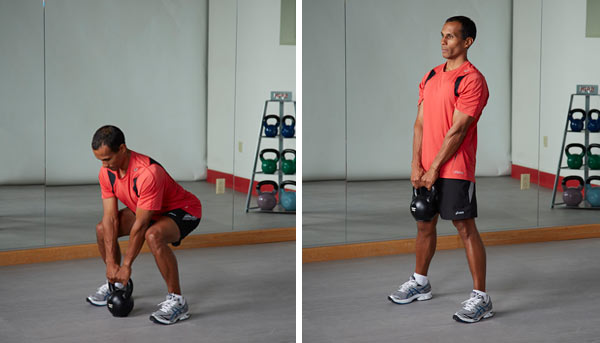 |
| The kettlebell deadlift is a beginner exercise that works nearly every muscle. |
Mobility and Stability Training
When
I refer to mobility I’m referring to range of motion about a joint or series of
joints. Stability is control in the presence of change. Where most people go
wrong is increasing their mobility through stretching without adding stability
to their newfound range of motion. This leaves one susceptible to injury. I’ve
also seen many cases where a lack of stability is the reason my client couldn’t
achieve the right position.
At
PPF I focus on developing mobility of your ankles, hips, and upper back, while
developing stability in your lower back and around your shoulder blades as per
the Joint-by-Joint Approach developed by Mike Boyle and Gray Cook.
Core Training
Core
training at PPF isn’t about making your abs burn with 30min of core work. While
this type of training might be beneficial for bodybuilding, the goal of core
training is to improve the function of your muscles in-and-around your midsection
and hips so that they work while you’re doing squats, push-ups and other
exercises. Therefore, only a few isolated core exercises are needed as every
exercise becomes a core exercise.
It
used to be that the core was trained by bending forward, sideways, and backward
with crunches, side bends, and supermen, but research by Stuart McGill has
shown us that there are safer more effective exercises such as planks, suitcase
carries, and bird dogs.
 |
| The suitcase carry develops core and hip strength without causing wear-and-tear on your spine. |
Conclusion
At Pratt’s Pro Fitness performance, health, and improved body
composition are developed through strength training with a focus on sound
technique and injury prevention. Everyone here trains like an athlete.
If
you or a friend have any more questions about Pratt’s Pro Fitness or any health
and fitness related questions, please contact me through my website listed below.
Stay fit,
Jonathan Pratt

No comments:
Post a Comment