Sunday, 19 January 2014

Greater Strength Equals Greater Function … Sometimes

Training for strength is a fantastic endeavour for everyone regardless of their health and fitness goals. Strength training enhances one’s ability to perform activities of daily living, improves body composition, and improves athletic qualities such as speed, agility, and jumping ability.

However, I was recently reminded that being strong doesn’t always carry over to improved movement quality. Watch from a minute onward as 76-year old Roy Mason deadlifts 529 lbs! While I wish I could lift that kind of weight I’d rather be able to move freely than have to shuffle along. I should also add that one can have a high degree of cardiovascular fitness and move poorly as well.


When I train myself or my clients developing strength is important as well as developing quality movement. Everyone can improve their movement quality even high level athletes. We start by foam rolling to improve muscle tissue quality. This temporarily improves muscle extensibility. Next we perform mobility work for the ankles, hips, and thoracic spine as well as stability work for the hips, lumbar spine, and scapular region. Following this isolated work we then work on integrating these exercises into basic movements such as squatting and lunging. That’s 15min out of a 60min session just for improving movement quality.

I measure movement quality through the Functional Movement Screen.

Now it’s time for developing qualities such as strength, power, and hypertrophy. But, this doesn’t mean that we’re not improving movement quality. Movements such as squatting, deadlifting, lunging, pushing, and pulling as emphasised instead of focusing on isolated muscles. In addition, as one recovers from performing a taxing movement such as a deadlift she works on improving movement quality with an easier exercise such as those from the warm-up.

The deep squat: A movement that most people lose over time.

Strength training is important for improving health and fitness, but basic movement quality must be addressed too. Fortunately, it’s easy to develop both without sacrificing one or the other. 

Stay fit,

Jonathan Pratt

Monday, 16 December 2013

General Conditioning for Runners

In the previous piece I provided a number of ways for developing qualities specific to a race. However, specific training is too tiring to perform on a daily basis and may not work on your strengths and weaknesses.

This brings me to general training. General training provides a foundation for specific training thereby allowing us to handle higher volumes of specific training in later phases. The most general training we can perform is to enhance movement quality, which consists of mobility and stability work. The next level involves training the general qualities of running: endurance, speed, and strength. This piece will focus on endurance or general conditioning. While general conditioning can take the form of any exercise(s) that elevate your heart rate for a considerable time I’ll be sticking solely to discussing running workouts.

Option 1: Short to moderate length runs at a low intensity. Training at 55-75% of maximum heart rate comprises over 80% of the training time of elite athletes across all endurance sports (Seiler and Tonnessen, 2009). According to Ultimate MMA Conditioning by Joel Jamieson (2009) these sessions develop the aerobic system by increasing mitochondrial density and capillarization of the slow twitch fibres and by increasing the volume of the left ventricle in the heart.

Paula Radcliffe was known for running regular 150 mile weeks

Option 2: Long Runs. Long runs develop the ability to use a higher percentage of fat as a fuel source in addition to achieving the benefits from option 1. While it was once thought that runs of roughly two hours or more recruited fast twitch muscle fibres this is no longer the case. It’s now believed that the FT fibres convert their glycogen stores to lactate and transport them to slow twitch fibres where the lactate is used as a fuel source. Regardless, long runs have some positive adaptations to fast twitch muscle fibres. The long run is necessary for competing in the marathon and half marathon, but its use at shorter distances – especially the middle distances – has been debated. Developing the ability to burn fat at a high rate interferes with the ability to burn glycogen at a high rate. It’s usually better to stick to higher weekly mileage in this case than to have a long run. Still, one of the greatest 800 m runners of all time Peter Snell was well noted for running 22 milers.
            800-1500m: 60-90 min
            5km-HM: 90-120 min
            Marathon: 2-3 hours

Option 3: Easy Runs with Variations. This is a fun way to spice up an easy run. By adding in some faster running for very short durations you can make an easier transition to harder training in later phases. I now use this method for most runs in my introductory phase of two to four weeks. These workouts can also be used in later phases so long as you can recover for harder workouts. All of these options work regardless of the event you’re training for; this is after all general training.
            15sec at 1500m pace every 3-5min
            25sec at 3000m pace every 3-5min
            30sec at 5km pace every 3-5min
            45sec at 10km pace every 3-5min
            3-5 x 30sec hill repeats at 5km pace
            The last 5-15min of a run done gradually faster

Option 4: Run/Walk. I use to laugh at the idea of taking a walk break in the middle of an easy run until I realized it was a great way to come back from an injury. By running at a faster pace for a brief period and then taking a walk break I could elevate my heart rate to 120-150 bpm for an hour without too much stress on my legs. In recent months I’ve become fascinated with the methods of Mihaly Igloi who back in the 1950s trained Olympic medalists and world record holders through daily interval training. He would have his runners run for distances of 100-400 m with short jogs and walk breaks thereby elevating the heart rate to above 120 bpm for three hours.
1-3min comfortably hard with a walk or jog break until your heart rate drops to 120 bpm for the same length as an average easy run


Option 5: Cross Training. Joel Jamieson’s book that I referenced above is an excellent source for developing the energy systems through a variety of methods. If you’re frequently injured, currently injured, or coming back from an injury his book is a fantastic resource.  

Stay fit,

Jonathan Pratt

Tuesday, 3 December 2013

Preventing Hamstring Strains

Hamstring strains are a common sports injury. So far the research has focused mostly on hamstring strengthening exercises, however I believe that maintaining healthy hamstrings requires a multifactorial approach. In order to prevent hamstring injuries one should work on strength, flexibility, posture, and motor control.

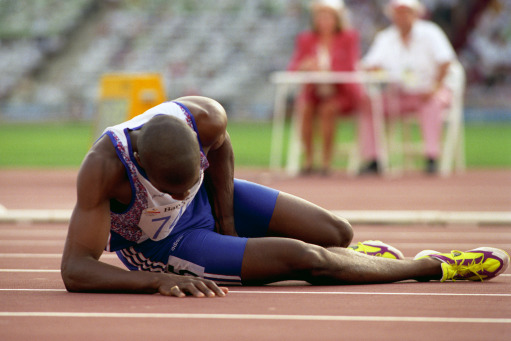
Derek Redmond at the 1992 Olympics in Barcelona was a favourite in the 400 m until injuring his hamstring in the semi-final.

According to a recent review all hamstring strains occur during high speed running (Guex and Miller, 2013). While there is some debate over which part of the running stride the injury occurs, Guex and Miller focused their discussion around injuries during the terminal swing phase of the running stride. The terminal swing phase occurs when the lead leg is swinging back toward the body in preparation for ground contact. During this phase the hamstrings are contracting at their fastest while being elongated by 9-12%.

The aftermath of a medial hamstring tear

Hamstring Strength Exercises

Guex and Miller (2013) suggest that the key to avoiding hamstring strains is to perform hamstring exercises at greater than 80% load from about 80 degrees hip flexion. They realize that this is difficult to do in practice, so combining a variety of hamstring exercises may suffice. Some good choices are variations of the deadlift (both bilateral and unilateral), hamstring curl, and pull-through.

The Romanian Deadlift trains the hip extension function of the hamstrings and glutes. This exercise should only be performed with instruction from a qualified trainer.

The Valslide Leg Curl trains the hip extension and knee flexion function of the hamstrings with the glutes extending the hips.   

Glute Strength Exercises

Another viewpoint comes from the works of Vladimir Janda and Shirley Sahrmann. Janda said, “He who treats the site of pain is often lost.” Sahrmann said, “When a muscle is injured, look for the weak synergist.” Both concluded that a weak gluteus maximus led to hamstring dominance. Thus, no matter how strong the hamstrings are they could become strained if the glutes aren’t assisting with hip extension.

The idea of weak glutes coincides with my own experiences. My hamstrings used to be sore for several days after every Monday interval session in grade 12 XC running. Hamstring curls worked for a while, but it wasn’t until I began performing isolated glute training that I began to notice something more permanent. For glute training exercises check out my post The Importance of Developing the Glutes.

Tight Hamstrings

Having short or stiff hamstrings may also lead to hamstring strains. Before you go about overstretching your hamstrings though make sure they’re indeed short. Interestingly, my wife has tremendous flexibility, but her hamstrings often feel tight.

Tight Hip Flexors

Having shortened or stiff hip flexors inhibits the function of the glutes and anteriorly tilts the pelvis. This places both the glutes and hamstrings in a stretched position thereby decreasing their function. Stretching as well as foam rolling of the hip flexors can be performed.

Poor Posture

While muscle activity can have an effect on posture, posture can also have an effect on muscle activity. I won’t elaborate too much on how to use this method as I’ve just recently started performing postural drills on myself. If you have an anterior pelvic tilt, spending time in a neutral spine position can decrease the tension in the hip flexors while restoring it to the hamstrings and glutes. In addition, the hamstrings and glutes no longer have to work from that stretched position.

Poor Motor Control

Gray Cook – creator of the Functional Movement Screen – has done a lot to teach us about muscle coordination (i.e. motor control). When we develop an anterior pelvic tilt it causes us to shift our weight forward leaving us with the lower back, hamstrings, and/or calves feeling tight. This would give us a poor active straight leg raise and toe touch pattern. Fix the dysfunctional pattern and these muscles magically get longer.

Leg Lowering Progression (not sure why this wouldn't embed)

In summary, preventing hamstring injuries is a multifactorial approach involving strength, flexibility, posture work, and motor control training.

Stay fit,

Jonathan Pratt

Tuesday, 26 November 2013

Different Training Methods for Running (Part 1)

A few years ago I met a guy in his first year of university. He was really strong and muscular. We talked about his training and he complained about how difficult it was to select a program. “Everybody is giving different advice,” he said. But, what he didn’t realize is that all successful programs have common themes; there are many workouts and systems that appear different on paper, but have the same effect. In this series of posts I’d like to discuss different workouts and periodization schemes for achieving improved performance in running. If you’re willing to study the underlying physiology or “waste” your time performing every program out there as I have you’ll discover similarities.

I’ve tried to simplify things by dropping the workouts into buckets without using scientific terminology; you could easily create your own categories based on pace or percentage of VO2max.

Important Note: I’ve given example workouts, but in order to be brief I wasn’t able to give examples for every fitness level. Therefore, these workouts may need to be heavily modified for your situation. Focus more on the description while using the examples as comparison to the other sessions.

Peter Snell defeating pre-race favourite Roger Moens in the 1960 Olympic 800 m.

Specific Training

I’ll start with event specific training and shoot off in either direction. The goal of event specific training is simply to replicate the demands of the race. This may be in the form of developing the energy systems or simply training at the speed of the race. Depending on your abilities and goals you may pick all of these options or just a couple.

Option 1: Race the event distance. This was a very popular means of training back in the 70s and 80s. By racing nearly every week runners required very little event specific training. However, the longer the event the less successful this method becomes. There are very few if any runners that are capable of running at their best for more than 2-3 marathons on an annual basis.

Option 2: Time-Trials of equal or shorter distance. While running the event distance replicates the race distance, running a shorter distance allows one to run at goal pace.

Option 3: Long Intervals with Full Recovery. These sessions are very difficult, so they’re only done a couple times a year and should not be done by young or inexperienced runners. Each interval will feel like a maximum effort during a hard training week, so don’t hesitate to take more rest.
            800m: 2-3x600m with 10-15min rest
            1500m: 2-3x1000m with 8-12min rest
            5km: 2-3x2000m with 8-12min rest
            10km: 3x3000m with 3-5min rest

Option 4: Medium Intervals with Short Recovery. These sessions can be done once a week in the latter training phases.
            800m: 5x400m with 4min rest
            1500m: 4-6x600m with 3min rest
            5km: 5-6x1000m with 90sec rest
            10km: 5-6x1mi with 90sec rest
            HM: 5-6x3000m with 3min rest
            Marathon: 3x10km with 1km jog rest

Option 5: Short Intervals with Short Recovery. These are moderately demanding sessions, so they can be done fairly frequently or as progressions to the other interval sessions.
            800m: 3x5x200m with 30-60sec between intervals and 5min between sets
            1500m: 3x5x300m with 45-60sec between intervals and 5min between sets
            5km: 15-20x400m with 30-60sec
            10km: 15-20x500m with 30sec rest

Option 6: Short Intervals with Long Recovery. These sessions are very easy and can be done in all phases of training. The goal is on biomechanics rather than energy system development.
            800m: 6-10x200m with 2min rest
            1500m: 6-12x300m with 90sec-2min rest
            5km: 12-16x400m with 90sec rest
            10km: 12-16x500m with 90sec rest

Option 7: Continuous Run
            HM: 10km Easy + 10km at Race Pace
            Marathon: 10mi Easy + 10mi at Race Pace
           
Option 8: Surging. These sessions are reserved for runners looking to qualify for championship finals and contend for medals. Sessions and sets within sessions are started at/slower than race pace and then the pace is kicked up a notch on subsequent intervals.
            800m: 3x(300, 200, 100m) with 90sec between intervals and 3min between sets
            1500m: 3x(400, 300, 200m) with 90sec between intervals and 3min between sets
            5km: 4x(1000m + 200m) with 60sec between intervals and 3min between sets
            10km: 4-5x(1600m + 400m) with 60sec between intervals and 3min between sets
            HM: 4x(2km + 1km) with 60sec between intervals and 3min between sets
            Marathon: 25km with 1km surges every 5km

This is far from an exhaustive list. All the rest sections in the above examples are passive, but one could use a jog recovery and extend the rest sections or subtract volume from the workout. Also, in most cases I used intervals of the same length at the same pace, but it’s boring to do 10-20 of anything. I love doing workouts like 2x6min at 10km pace, 2x4min at 5km pace, 2x2min at 3km pace with 2min rests.


In the next piece, I’ll discuss how to develop general conditioning in order to handle higher volumes of specific training. 

Stay fit,

Jonathan Pratt
Pratt's Pro Fitness

Monday, 4 November 2013

A Balanced Take on the Stretching Debate

Recently on Letsrun.com a poster started a thread claiming that “All Stretching Is A Waste Of Time.” Many posters agreed or partially agreed with this claim citing scientific research. Others disagreed with the claim and backed it up with stories of how stretching worked for them. I think we can learn from both sides to improve movement quality, reduce the risk of injury, and improve sports performance.

If you would like to read what science has to say about stretching for yourself you can read the 73 summaries of warm-up science posted here.

Types of Stretching

There are many types of stretching, but here is a list of the most commonly used techniques:

Static Stretching: Holding the stretch position for anywhere between 10 s and many minutes. Unless otherwise stated “stretching” will refer to static stretching throughout the rest of this piece.
Dynamic Stretching: “Controlled movement through the active range of motion” (Fletcher and Jones, 2004)
Active Isolated Stretching (AIS): Holding the stretch position for no more than 2 s while simultaneously contracting the muscle’s antagonist. Perform multiple repetitions. AIS can be thought of as a type of dynamic stretching.
Proprioceptive Neuromuscular Facilitation (PNF): Contract a muscle for several seconds while it’s in a stretched state, relax, move deeper into the stretch, and repeat

Stretching As Part of the Warm-Up

It seems that the initial negativity towards stretching comes from research showing that stretching during the warm-up led to decreased performance. Studies show a 3-30 % reduction in power output! Behm and colleagues (2004) showed that stretching led to a 9.2 % reduction in balance and a 5.8 % reduction in reaction time. Nelson and colleagues (2005) also showed that stretching impaired muscular endurance. Similar findings have been shown for PNF.

On the other hand dynamic stretching has routinely been shown to improve subsequent performance. According to Fundamentals of High School Strength and Conditioning 2nd Ed. (Brooks and Colleagues, 2012) dynamic stretching has been shown to “improve performance in 20 m sprints, jumping tasks, and agility tests; increase dynamic range of motion; and reduce injury rates when compared with static stretching programs.” Therefore, it would appear that stretching should not appear during the warm-up.

Looking a little bit closer at the research reveals some issues with methodology. The methodology doesn’t follow the advice given by coaches. Firstly, the stretches are held for too long – up to 30 min per muscle group! Most coaches recommend 15-30 s stretches during the warm-up. Secondly, stretching is used as the sole method of warming up. However, when coaches employ stretching in the warm-up it may be preceded by 5-10min of aerobic work and followed by dynamic stretching; it’s always concluded with sports-specific drills.

Interestingly, there’s some research in the link I provided showing that stretching for 15-30 s improves flexibility to the same degree as 45-60 s stretches, but without the subsequent decrease in performance. The link also has research that shows that any decrease in performance from stretching can be reversed with a sports-specific warm-up.

Stretching for Injury Prevention

Contrary to popular belief stretching does not prevent injury … according to the research. However, stretching seems to be employed effectively by many individuals and physical therapists.

The problem with science as it pertains to this particular topic is that science reports averages and standards of deviation. What the science is reporting is that stretching does not prevent injuries for the majority of people using a generalized stretching protocol.

A good coach or physical therapist knows how to manipulate stretching for the needs of his clients/athletes. For example, an individual that’s hypermobile has too much range of motion and is unable to control her full range of motion. Stretching would thus make her more vulnerable to injury. She needs lots of stability work. Similarly, the low back often has adequate range of motion, so most people – including those with low back pain – would be better off to avoid stretching the low back and instead improve range of motion about the hips while working on core stability. Also, avoid stretching the neck as it’s a sensitive area. Leave the low back and neck to chiropractors and other health care professionals.

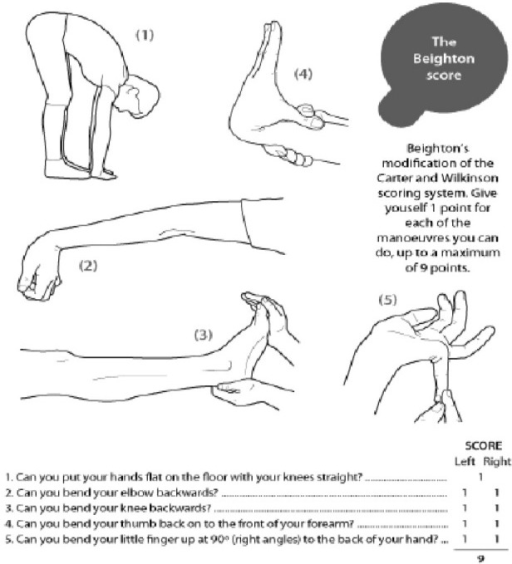
Your Beighton score determines hypermobility

Another example of a coach manipulating stretching for the needs of an individual is with myself. When I first began stretching my hip flexors my low back pain went away. If I don’t stretch my pectoral muscles before bed I wake up with pain in my upper back. On the other hand, stretching my hamstrings because they were always sore and I couldn’t touch my toes was a bad idea. My hamstrings were always sore because my glutes were weak and I couldn’t touch my toes because I was lacking stability elsewhere.

Gymnasts are incredibly flexible, but many lack the stability to perform a deep squat.

Stretching Recommendations

1. Start with foam rolling to improve the outcome of your stretching
2. If you have time to stretch before exercise stretch problem areas for 20 s. If you haven’t been assessed         it’s a safe bet to stretch the pecs, lats, hip flexors, calves, quads, adductors, and hip external rotators. I        don’t include it in my warm-up process, but I don’t have an issue with anyone that does. I prefer active          isolated stretching instead.
      3. Perform optional aerobic warmup either before or after stretching
      4. Perform mobility (dynamic flexibility) and stability exercises. If you’ve gained range of motion you need to     be able to control that range of motion with stability exercises.
      5. Perform task-specific drills
      6. Train or compete
      7. Follow up with more foam rolling and stretching. I prefer to stretch right before bed as it helps me unwind.

In conclusion, stretching can be used to improve movement quality, reduce the risk of injury, and improve sports performance. Stretching is neither good nor bad; it depends on who’s using it, how he’s using it, and when he’s using it.

Stay fit,

Jonathan Pratt


Sunday, 27 October 2013

Altering the Autonomic Nervous System for Improved Health

Just before posting this piece I was looking at an exercise physiology textbook published in 2007. It only had two pages devoted to the discussion of the autonomic nervous system and it didn’t discuss the effects of exercise on it. That’s because most of the research is relatively new.

According to Fundamentals of Human Anatomy and Physiology 6th Ed. (Martini, 2004) the autonomic nervous system (ANS) “coordinates cardiovascular, respiratory, digestive, urinary, and reproductive functions … and it does so without instructions or interference from the conscious mind.” When discussing the ANS a lot of complex terms are used, so bear with me as I get the definitions out of the way. Altering ANS output for improved health is a rather simple process.

The ANS can be divided into the sympathetic and parasympathetic divisions. In order to feel great and remain healthy we need to strike a balance between the two systems. Increased output from the sympathetic nervous system “stimulates tissue metabolism and increases alertness” (Martini, 2004). Maximum output from this system is known as the fight or flight mechanism, which is experienced during extreme duress. Increased output from the parasympathetic nervous system “conserves energy and promotes sedentary activities” (Martini, 2004).


Parasympathetic Nervous System (PNS)

Activities that increase PNS output include low intensity/long duration exercise such as walking and running, yoga, static stretching, massage, diaphragmatic breathing, and sleep. These activities are excellent for lowering stress.


Sympathetic Nervous System (SNS)

Activities that increase SNS output include high intensity interval training (HIIT), sprinting on flat ground and uphill, plyometrics, and weight training with moderate to heavy weights*. These activities improve energy levels and metabolism. I was at a presentation by Dr. Mark Swain from Inside Out Chiropractic and he referred to research on posture and the autonomic nervous system. If you’ve been sitting in a slumped posture all day you may start to feel tired due to increased PNS output. The trick is to sit up tall for a few minutes until your energy levels return.

*Warning: Sprinting and some plyometrics are higher risk activities and should only be used for advanced athletes.  

Putting It All Together

If you have a lot of stressors in your life include more PNS activities. When I was working a lot of midnight shifts in addition to running my business and volunteer coaching I would be short on sleep and would often miss several weeks of running. This led to an increase in resting and training heart rates among other things. While you can say that this occurred due to being out of shape a single 30min run would return my heart rate to normal for the next day. Aerobic fitness doesn’t return that quickly. Yoga and static stretching are excellent activities to perform before you go to bed but maybe not before a workout.

If you’re lethargic all the time or your exercise regimen is limited to PNS dominant activities, then include more SNS activities. I’ve found that if I run for several weeks at high volume without performing weight training or hill sprints that my legs feel very heavy. When I choose to accelerate my body doesn’t respond. After a few hill sprints my legs feel immediately fresher. Most people will need at least 48 hours rest after hard high intensity activities. Hill sprints may be too aggressive for you, but most people can learn to safely perform squat and deadlift variations with moderate to heavy weight.

While stress increases SNS output it doesn’t necessarily mean that one needs to avoid these activities. Short weight training sessions can be used a couple times a week, but HIIT training should probably be avoided.


In order to maximize our health we need to avoid focusing on one or two aspects of fitness and neglecting the others.

Stay fit,

Jonathan Pratt

Wednesday, 2 October 2013

Key Principles of Running

A couple months ago I gave a presentation on running titled In Defense of Running named after Michael Pollan’s book In Defense of Food. Pollan discusses how indigenous tribes thrive on vastly different diets, because there is one common theme: they eat real food. In comparison I discussed how there were many successful programs, but despite their differences there was also a common theme: there was a lot of running involved! I thought I’d share some of the ideas from that presentation.

There’s a lot that we can learn from studying the science of running, but it’s not necessary to have a strong science background in order to develop an effective program. We have more than one hundred years of trial-and-error evidence by thousands of coaches and millions of runners that’s easily available to anyone. From these individuals we find that although methods vary there are several common principles:

Consistency is the key: Long term success in running is not determined by some amazing workout or training week but through months and years of good and even average workouts. The best workout you can do takes too long to recover from and can lead to injury. These should be done sparingly.

Individualized training is great, but so is training in a group: If we take many runners preparing for the same event they will all have different backgrounds and different needs even if they run the same time for that event. Thus, these runners should have some individualization to their training. Having said that, group training has tremendous benefits psychologically which transfers into physical improvements. The goal then is to individualize training within the group.

All the elements of a program are important: It’s not all about the long run or interval workout or high mileage.

You need to run … a lot: Yearly increases in running duration and frequency are necessary for continued improvements for both middle and long distance events. Training at lower intensities allows one to recover more quickly from race specific intensities both during and after interval training sessions.

Paula Radcliffe won World Jr XC on only 25-30mi/week, but it took 120-160mi/week to become one of the best ever.

Research by Seiler and Tonnessen (2009) reveals that elite runners spend about 80% of their training at below 75% maximum heart rate. While this has worked very well for elites Esteve-Lanao wanted to know if it was applicable to recreational runners. He found that these runners tended to run too fast on their easy days and were therefore unable to achieve the necessary intensity on their hard days. When Esteve-Lanao (2007) made another group strictly adhere to running below 75% MHR on easy days they outperformed a group following a higher intensity protocol over 10km. While some elites “hammer” their easy runs they’re still running moderately high volumes and rarely exceeding their marathon race pace.

Easy runs at less than 75% maximum heart rate allow one to develop the cardiovascular system and aerobic energy pathway, but at an intensity low enough that it spares carbohydrate stores for race specific work. These runs also develop fat burning capability for events over 60min. The use of a designated long run is optional for events shorter than 60min.

Don’t forget interval training: While general conditioning improves the capacity of your engine interval training improves your engine’s power. This gives you a higher work rate.

For race pace training I use race pace +/- one event. Using the 10km as an example I use 5km to half marathon pace. For speed work I run up to two events faster i.e. up to 3km pace for the 10km.

There are many examples of runners that reached a world class level without interval training. These runners will often feel that they got slower from regular interval training. For example, Ron Clarke significantly lowered the 10 000 m world record just by running high volume and running hard on some of those runs. However, Clarke could never win major championships, because his engine wasn’t powerful enough to change pace quickly. He needed interval training, but he needed to use it sparingly to avoid breakdown.

Include some form of training to develop the stride: This type of work improves performance by increasing stride length, increasing stride rate (through decreased ground contact time), and lowering energy consumption at any particular pace (i.e. it improves running economy). The methods used vary dramatically from program to program but may include any or all of the following: form drills, plyometrics, weight training, hill running, and sprinting.


Stay fit,
Jonathan Pratt