Tuesday, 6 January 2015

Strength Training for Runners (Part 1)

Strength training is a highly debated topic amongst runners; some believe it’s a waste of time and could hinder performance, whereas others swear by it. The former group either hasn’t tried strength training or tried and failed. There are a lot of misconceptions surrounding strength training for runners and even many elite runners are performing poorly designed workouts with poor exercise technique. If you’re not willing to perform a strength program designed by someone who dedicates their life to learning about strength training, then you are probably better off not strength training. However, strength training for runners is supported by the scientific literature and performed by many of the most successful runners of all time. Here are some notable runners that follow(ed) a strength training program:

Herb Elliott: 1960 Olympic 1500 m champion, undefeated at 1500 m and the mile
Sebastian Coe: 1980/1984 Olympic 1500 m champion/800 m silver medalist, world record holder at 800 m (16 years), 1000 m (19 years), 1500 m, and 1 mile
Hicham El Guerrouj: 4 time world 1500 m champion, 2004 Olympic 1500 m/5000 m champion, current world record holder at 1500 m, 1 mile, and 2000 m
Mo Farah: World and Olympic Champion at 5000 m/10000 m
Paula Radcliffe: Current women’s world record holder in the marathon

Sebastian Coe left no stone unturned. Coe could squat to below parallel with 190 lbs for 5 reps at a bodyweight of 130 lbs (Martin and Coe, 1997).

In Part 1 I will discuss common reasons runners avoid strength training. Part 2 will discuss the benefits of strength training for runners, and Part 3 will discuss how I program strength training for runners at Pratt's Pro Fitness.

Common Reasons Runners Avoid Strength Training

Fear of Bulking Up

Having large muscles does indeed hinder running performance, but don’t worry. Much to the chagrin of many teenage boys gaining muscle mass isn’t easy. Significant muscle hypertrophy requires hard work, a good program, the right diet, and good genetics. The difference between a strength training program for runners versus a program for bodybuilders, weightlifters, powerlifters, strongmen, or even team sport athletes is that the program for runners involves lower training frequency, duration, and rate of perceived exertion (RPE). In addition, high volumes of running is counterproductive to building muscle (Joyce and Lewindon, 2014). With the right program the runner will gain strength with little to no gains in muscle mass.

They tried and failed

Runners often fail with strength training, because they do too much volume. Running is an endurance sport so it makes sense to train for muscular endurance. So, you look up how to train muscular endurance and sources may tell you 3 sets of 20 reps at 30-50% 1RM. Twenty reps is too many to develop strength and too few to develop endurance for a sport that requires hundreds to thousands of muscle contractions (Joyce and Lewindon, 2014). This type of work also develops a lot of fatigue. Instead, muscular endurance can be built by performing hill repeats or performing long runs and tempo workouts on hilly courses.

Another mistake runners make is that they train too hard in the weight room. The most important part of a runner’s program is the running component. Strength training is important, but working too hard in the gym uses up energy that could be better directed toward your running. A little strength goes a long way!

Runners also fail to see improvements with strength training, because they train on their own with a poorly designed program. I’ve even seen videos of elite runners performing exercises poorly. Other runners will perform exercises that are too advanced for their level of strength, perform bodybuilding routines, or train with too much volume. No wonder strength training doesn’t work for runners!

This is how most people look when performing the inchworm a push-up

Risk of Injury

Lifting weights happens to be one of the safest physical activities one can do when properly supervised. Hamill (1994) showed that the risk of developing an injury while training for the sport of weightlifting or engaging in weight training was significantly lower than training for running or any of the team sports. Weight training is also good for young athletes. A meta-analysis published in the journal Pediatrics collected 60 years’ worth of research showing that strength training – including with weights – was both safe and effective for ages 6-18 (Behringer and Colleagues, 2010).  

Believing that hills are all you need

Some runners will develop enough strength from hills to run well and stay injury free. I can’t deny that there are a number of elite runners that have succeeded using hill work instead of weight training. However, I can’t promise that you will achieve the necessary level of strength without weight training. In 2011 I removed weight training from my program to test the efficacy of solely using hills for strength training. Not only did I notice the strength loss, but I didn’t even feel well. In addition to hills, certain weight training exercises may be needed to fix the muscle imbalances that have been causing your injuries. 

In conclusion, there are numerous reasons why runners avoid strength training due to misconceptions and poor programming. 

Stay fit,

Jonathan Pratt
Pratt's Pro Fitness

Wednesday, 10 December 2014

Improving Flexibility

I’ve always been known to have poor flexibility. When I was a kid my mother heard that many kids were unable to touch their toes. She thought, “There’s no way that my kids can’t do it.” Sure enough I couldn’t touch my toes. Thus, over the years I’ve made numerous concerted efforts at increasing my flexibility. Sometimes I was successful and other times I wasn’t. In fact, one I spent an entire summer stretching my shoulders only to have no improvement in flexibility. That’s because flexibility training is more than static stretching. While I didn’t always see gains in flexibility, I saw other positive changes such as improved function of certain muscles and the elimination of pain.

The scientific research hasn’t been particularly kind to stretching. The research tells us that “too much flexibility may limit performance and increase the risk of injury” (Joyce and Lewindon, 2014). Still, injury rehabilitation experts have been successfully using stretching in their treatment protocols for years. For a more thorough piece on the use of stretching for performance and injury prevention please read my article A Balanced Take on Stretching Debate.


I recently started stretching again after reading High Performance Training for Sports. The flexibility training chapter which was written by Sue Falsone exposed me to some new research. Although static stretching reduces performance in the short-term, in the long-term it increases the isometric strength and contraction speed of a muscle both of which are useful to athletic performance (Joyce and Lewindon, 2014).


 If you train team sport athletes you need to read this book!

This time my stretching regimen was a lot different. I decided to focus on one muscle at a time, so that I wouldn’t give up after a few weeks due to insufficient time. I also added several other techniques to increase my flexibility: breathing drills, soft tissue work, strength of the muscle at its end range of flexibility, and strength of the opposing muscle groups.

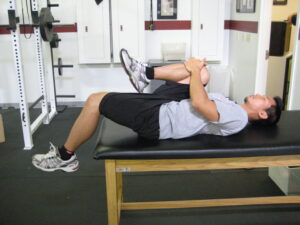
The first muscle I worked on was the rectus femoris – a muscle that extends the knee and flexes the hip. I have previously tested this muscle to be short with the Modified Thomas Test.


This is what my Thomas Test looked like. My leg now comes down to the table. 

The Postural Restoration Institute tells us that posture affects muscle tone and breathing affects posture. In fact, the diaphragm is important for posture and motor control as well as for breathing (Courtney, 2009). Breathing drills alone have improved my flexibility. So, I would start every session with deep diaphragmatic breathing with my spine in a neutral position for 5-10 breaths.

This drill is effective for reducing anterior pelvic tilt.

Next I alternated between foam rolling and stretching. We don’t know why foam rolling – or massage therapy for that matter – works, but it does. Interestingly, we now know that stretching doesn’t increase the length of the muscle but rather improves flexibility by modifying sensation (Weppler and Magnusson, 2010). According to a recent study by Mohr and Colleagues (2014) combining stretching and foam rolling has an additive effect on flexibility. I foam rolled the muscle for 60sec and then stretched it for 60sec performing each for three rounds.

The third part of the session involved a technique called proprioceptive neuromuscular facilitation or PNF for short. From a stretched position I contracted the stretched muscle for 5sec, relaxed, moved into the newfound range of motion, and repeated until I couldn’t comfortably stretch any farther. At that point I contracted the muscle’s antagonists: the gluteus maximus and hamstrings.

Finally, I concluded the session by performing a strength exercise for the glutes into the new range of motion. I performed 10 glute bridges. Developing strength and control in end-range positions is necessary to maintain flexibility and prevent injuries. The combination of these four techniques has given me normal hip extension range of motion. Following this experiment, I was able to restore shoulder flexion.


Improving flexibility can help or hurt an individual in terms of athletic performance and injury prevention. When increased flexibility is needed, it may be necessary to combine a variety of protocols and it’s important to be able to control this newfound range of motion.

Stay fit,

Jonathan Pratt

Monday, 3 November 2014

The Black Hole of Training

One of my favourite training quotes for running is, “Make your hard days hard and your easy days easy.” I think the individual who came up with this quote was 1972 Olympic marathon champion Frank Shorter. Shorter often complained that he couldn’t find any training partners who wanted to run slow enough on easy runs, but then were unable to stick with him on the hard days.

Frank Shorter finishing the 1972 Olympics in Munich. Shorter averaged 140 miles/week for the entire 1970s.

            Recently I watched a seminar with exercise physiologist Stephen Seiler. I’ve been a big fan of Seiler over the last year, because he not only studies endurance training, but also studies what elite endurance athletes do for training. He found that elite athletes across all endurance sports spend at least 75-80% of their training at very low intensities (55-75% of maximum heart rate). Another 5% of training is spent at 75-85% max HR and the remaining 15-20% is performed at greater than 85% max HR.
            Contrast this with sub-elite and recreational runners. According to Seiler, both groups tend to spend much more time training at 75-85% max heart rate. Seiler calls this the “black hole” of training and it’s usually achieved by running too fast on designated easy days. This type of training ends up being too fast for recovery purposes, yet too slow to develop race specific qualities. The end result is your race specific intervals are too slow, because you tired yourself out the day before.
Running too hard on easy days is a common problem amongst high school and university runners. It’s really hard to force yourself to run at lower than 75% max HR. Hammering easy days would’ve gone by the wayside a long time ago except for the fact that it actually works gets one fit fairly quickly. There is a downside though! Back in the 1980s when Portugal was one of the top running nations data was collected on their national level male runners. Those who were doing a lot of sessions at 75-85% max HR (i.e. hammering their easy days) had fewer years at the national level than those who spent more time at lower intensities. As well, this group wasn’t quite as fast as the other group.
             If you’ve spent enough time studying the training of elite runners you might ask about Hicham el Guerrouj. He often dropped down to 3:00-3:10/km on his easy days and occasionally 2:50/km. However, as fast as this seems the world record pace for the marathon is 2:55/km. So, relatively speaking he wasn’t running that fast. Keep in mind too that El G had better running genetics than just about anyone that ever lived, was running 70-100 miles/week, and didn’t have school/work interfering with his recovery. Late in his career it would’ve been necessary to go a little faster in order to see continued gains, but as interval training intensified and the competitive season approached he ran slower on his easy runs.

Benefits of Running Slowly

            According to running coach John Kellogg, running at low intensities allows one to run without straining. The best athletes in every sport always make things look effortless. By learning how to run without straining you become more economical. Seiler also believes that low intensity running is the key to improving economy as it allows one to practice the skill of running for longer. There are also cardiovascular benefits that develop better at low intensities. In Ultimate MMA Conditioning Joel Jamieson says that at high heart rates the heart contracts before it fully fills. Thus, training at lower heart rates allows the heart’s left ventricle to expend thereby improving the pumping capacity of the heart. Finally, higher intensity interval training turns up our fight-or-flight mechanism, which releases a lot of stress hormones. By going very slow the next day we turn up our rest-and-digest system thereby aiding in recovery, but still allowing for increased running adaptations.

            In conclusion, one can improve running ability through a variety of ways. However, in order for most runners to maximize running performance and have a longer career it’s best to spend most of one’s time training at very low intensities with about 15-20% of training at higher intensities. 

Stay fit,

Jonathan Pratt

Monday, 7 July 2014

The Value of Keeping a Training Log

           When I was 15 I received my first training log for runners. It had training tips, pace charts, comparison charts, and a place to graph your weekly mileage. Being a fan of details I recorded everything including the people who ran with me as well as the animals I saw on my runs. Over the years I’ve gotten away from recording much of my training to my detriment. It can be as simple as writing the sets and reps of a strength workout or km run in a notebook to an online training log.

My first training log

            The first benefit of a keeping a training log is to track progress. Sometimes you have some terrible workouts and it can get you down, but then you look at your training log and get to see just how far you’ve come. Also, if your progress comes to a halt your log might indicate why. Maybe you’ve missed a lot of workouts or you’ve been doing the same program for too long (or you switch programs too often).
Another benefit of the training log is that it allows others to give you feedback on your training. One time a friend of mine felt he was in good shape, but he wasn’t doing as well in races as he would’ve liked. After examining his training logs I could see he was doing a lot of things right; he was running solid weekly mileage, tempos, and race pace intervals. However, he was getting next to no training at faster than race pace. Considering that it was the end of the season and speed work was his strength I suggested a few workouts at much faster than race pace. It was an instant breakthrough. In addition, a coach or physiotherapist might be able to determine why you were injured. Maybe you progressed volume too quickly, made a sudden change in intensity or terrain, or changed shoes recently. Recording the date you bought your shoes can be helpful in this regard.
            You may also find a training log useful for accountability. It sucks to see a bunch of blank spaces where you skipped workouts.
            I think the most important benefit of keeping a training log though is that it provides one with accurate information about past training which can be used for future training. I have a pretty good memory, but over time performances become inflated. For instance, a common workout I used to perform for cross-country season was 6x1km (60-90sec) rest. After a layoff I came back and was disappointed that I was running my intervals 10sec too slow. The problem wasn’t that I was running too slow, but rather that I was remembering my all-time best performance as the usual. My training log revealed that I was right on schedule.

            Training logs offer the ability to track progress, receive feedback from others, hold one accountable, and provide accurate information about past training.

Stay fit,

Jonathan Pratt

Wednesday, 4 June 2014

Measuring Body Composition

I came up with the idea for this piece after a good laugh I had the other day. I recently decided to take up running again and thought it would be great to use my heart rate monitor periodically to track my fitness. The watch required a new battery which meant that all the previous settings were lost. When I entered my height and weight, to my surprise, the watch displayed, “BMI … 25.0 … Overweight.” Apparently well-defined muscles is overweight these days.  

BMI or Body Mass Index is calculated by taking your mass in kg and dividing it by your height in m squared. A BMI of 25.0 is on the edge of normal and overweight. The problem with BMI is that it assumes that everyone that’s heavy is heavy because they’re fat. Well-muscled people also happen to be heavy. BMI is best used to look at populations, but is inappropriate for individuals. If the population has an average BMI of 33, this is a cause for concern as the average individual is obese.


            Similarly, simply weighing yourself is a poor method for measuring changes in body composition. The scale may not have budged, but you could’ve lost several pounds of fat and replaced that with muscle thereby improving your body composition. Conversely, the scale may read a lower number but most of the weight lost came from muscle and water loss.


Dual energy x-ray absorptiometry (DEXA): This is the most accurate method of measuring body composition, but it’s not readily accessible for most.

Hydrostatic underwater weighing: This method is also very accurate, but again it’s not readily accessible for most.

Skinfold measurements: While less accurate than DEXA, it’s more accurate than the scale and it can be done at home. Instead of converting the numbers to a percent body fat it’s better to just look for improvements in each measurement over time as body fat can redistribute itself.

Bioelectrical impedance: The device for measuring this is easy to obtain, but it can be thrown off by fat distribution.  

Waistline measurements: This is a little less accurate than measuring skin folds, but it’s quicker and requires less skill.

Looking in the mirror: While this method is qualitative I still prefer it over the scale. If you look better your body composition has improved.

Clothing fit: If your clothes fit better you’ve lost body fat. If you’re trying to gain muscle your clothes will feel tighter.


If you’re looking to improve body composition focus on more subjective measures such as looking in the mirror and comparing clothing fit. On a weekly basis use skinfold or waistline measurements and only occasionally should you look at the scale.

Stay fit,

Jonathan Pratt

Monday, 5 May 2014

Patellar Tendinopathy (Jumper's Knee)

Last summer I was working with an athlete that had missed some time from his sport due to some knee pain. In order to speed his return to action and prevent further issues he took some time off from his sport and worked on his strength and movement quality.


The knee pain was diagnosed as patellar tendinopathy or jumper’s knee. The patellar tendon runs from the quadriceps muscle group to the knee cap (patella) and into the shin (tibia). When injury is sustained to this tendon pain is felt below the knee cap. The injury is often called patellar tendinitis, however ‘-itis’ refers to inflammation and with the exception of a little inflammation at the beginning the tendon actually degenerates.

Programming

Patellar tendinopathy is an overuse injury, so the first thing that needed to be done was to reduce training for his sport. The exercises that I gave him were really exercises that are a part of any good program with a careful eye on completing them with the absence of pain. 

Foam Rolling

This form of self-massage was done for all the muscles that cross the knee joint: the hamstrings, adductors, calves, glutei maximi and tensor fascia latae (indirectly through the iliotibial band), and in particular the quadriceps. 

Mobility Work

I subscribe to Mike Boyle’s and Gray Cook’s Joint-by-Joint Approach to Training. It’s based on the theory of regional interdependence, which means that dysfunction in one area can lead to injury at a distant location. Indeed, recent research shows that poor shoulder flexion range of motion is associated with low back pain in male high-divers (Narita and colleagues, 2013). In the case of a knee injury it’s important to focus on ankle and hip mobility. Interestingly, this athlete has been treated for reduced mobility in his right big toe which causes that foot to turn out especially while running. 

Isolated Muscle Strengthening

According to Chuter and colleagues (2012) there is an increased risk of leg injury due to core weakness, weakness of the hip abductors and hip external rotators, and poor control of the lumbopelvic hip complex. This is supported by Shirley Sahrmann’s two textbooks which show that just about all knee pain can be treated by strengthening the hip abductors/external rotators as well as the quadriceps.* It was previously determined by both myself and a physiotherapist that this athlete had weak glutei maximi which – when functioning properly – are the strongest hip external rotators.

*Note: Sahrmann warns that quadriceps strengthening could accelerate knee osteoarthritis, so if your client has knee OA please refer them to a physiotherapist for guidance.

Band Resisted Terminal Knee Extension

Band Shuffle

Integrated Strengthening

It’s great to train weak muscles and improve joint mobility, but the body is much more than a bunch of parts. This is where lower body movements such as squatting, lunging, and hip hinging come into play.

I employed the use of the front squat, Romanian deadlift, Bulgarian split squat, single leg squat, and the single leg Romanian deadlift. These muscles strengthen the quadriceps, hamstrings, and glutei. Research shows that patients with patellar tendinopathy benefit from eccentric strengthening of the quadriceps, and stretching of the quadriceps and hamstrings (Dimitrios, 2012). The stretch in the rear leg while performing the Bulgarian split squat is great for training the first two qualities. In addition, a review by Kristensen and Franklyn-Miller (2012) shows that heavy weight training leads to better results than eccentric strength training due to reduced swelling of the tendon as well as increased vascularization and increased collagen turnover. The latter three exercises improve control of the lumbopelvic hip complex (i.e. improve balance through improved hip stability).

Bulgarian Split Squat
I prefer to hold dumbbells at my side.

In order to prevent or recover from patellar tendinopathy it's beneficial to foam roll the muscles of the hip and thigh, stretch the quadriceps and hamstrings, perform single leg strength exercises, and lift heavy weights.

References

Comparing the effects of eccentric training with eccentric training and static stretching exercises in the treatment of patellar tendinopathy. A controlled clinical trial, by Dimitrios, Pantelis, and Kalliopi, 2012.

Critical factors for the prevention of low back pain in elite junior divers by Narita, Kaneoka, Takemura, Sakata, Nomura, and Miyakawa, 2013

Diagnoses and Treatment of Muscle Impairment Syndromes by Shirley Sahrmann, 2002.

Movement by Gray Cook, 2010.

Movement System Impairment Syndromes of the Extremities, Cervical and Thoracic Spines by Shirley Sahrmann, 2011.  

Proximal and distal contributions to lower extremity injury: A review of the literature, by Chuter, Xanne, and de Jonge, 2012.

Resistance training in musculoskeletal rehabilitation: a systematic review by Kristensen and Franklyn-Miller, 2012.

Stay fit,

Jonathan Pratt


Wednesday, 16 April 2014

Recovery from Training

A few weeks ago I had the opportunity to give a talk on recovery and training for speed to a group at Active Running training for the Around the Bay 30km race. ATB is the oldest annual running race in North America having begun in 1894. Here are my thoughts on recovery.

Recovery was a great topic for me to discuss for a couple reasons. Firstly, I had to have a conversation with one of my clients about it only a couple weeks before so the topic was fresh in my mind. Secondly, recovery is something that I ignored for most of high school much to my detriment. While I was in great shape I often performed poorly because fatigue masks fitness.

Shortly before I entered my final season of high school XC my mom found me a used copy of Lore of Running 3rd edition by Dr. Timothy Noakes (it’s now in its 4th Ed.). What a great find! After reading the same information month after month in magazines I was beginning to think I knew everything there was to know about running. However, LOR had 800+ pages on the science of running and great anecdotes too.


What really stood out to me was the part on overtraining. This was a term I had never heard of until then. I always thought the harder the training the better. But as I looked over the list of symptoms and discovered that I had experienced most of them I knew things had to change. But, rather than continue on with how to spot overtraining – which is a poorly defined term – I’d like to discuss how to maximize recovery.

In order to maximize recovery one needs to think about recovery on a daily, weekly, monthly, yearly, and even a multi-year basis. All of these are useful for recovering both physical and psychological qualities. Training hard is important, but all your gains occur while you’re recovering.

If you’re one of the fittest people on the planet then you’ll focus your training on the Olympic Games and have years where you’re training harder and with more specific training versus other years training relatively easier and focussing on more general physical qualities. Most of us aren’t ever going to be at that level, so we can step back to thinking about yearly recovery. Yearly recovery involves taking one or two 2-4 week blocks during the year where training is reduced or eliminated or one engages in other fitness modalities. Something like this isn’t necessary for the general fitness enthusiast, but is a must for a competitive athlete. On a monthly basis recovery can take the form of an unloading week every 3-6 weeks where the volume and/or intensity is reduced. Not all my general fitness clients train hard enough to need these, but they’re great for working on exercise technique.

The most detailed part of the talk involved weekly and daily recovery. Weekly recovery involves harder and easier training days as well as complete rest days or even switching to a different activity. What we want to be aware of is providing balance to the autonomic nervous system. For those of us who enjoy training for the endurance sports we need to perform some high intensity activities that stimulate the sympathetic nervous system. These activities are also great for stimulating growth hormone and testosterone production while minimizing cortisol production thus improving or maintaining body composition and aiding in recovery. For those who enjoy speed and power sports you need to perform some low intensity activities that stimulate the parasympathetic nervous system. 

Daily recovery involves focussing on nutrition, sleep, and relaxation. When we work out exercise causes breakdown on muscle tissue and temporarily decreases fitness. It's during the recovery period where all the results occur.


For nutrition focus on eating whole foods such as fruit, vegetables, and lean protein and drink plenty of water. While older sources have deemed it a must to eat a meal within 15-60 min after exercise recent research is beginning to show that good nutrition over a 24 hour period is much more important. So, if you ate a large meal a couple hours before your workout or competition and you don’t feel hungry right after you don’t have to worry about getting in an immediate recovery meal. On the other hand, if you ate well before your workout/competition or you have multiple workouts/competitions that day eating a meal immediately after would be a wise decision.

Sleep is also very important. Most often 8 hours of sleep a night is recommended, but some may need more or less. It’s important to experiment. While sleeping the body moves in and out of light and deep sleep (REM) with each cycle lasting approximately 90 min. Waking up in the middle of a cycle leaves one feeling terrible even if the total length of sleep was fairly long. One of my runners recently mentioned that he had been going to bed 30 min earlier, but it had made him feel worse. Play around with sleep lengths to find the optimal length of sleep. Naps are also great! Usually sleeping for 10-20 min will leave you feeling rested, whereas 30-45min might leave you feeling terrible. Also, to aid in getting to sleep quickly it’s beneficial to turn off all electronics 30-60 min before bed. The blue light from television and computer screens stimulates wakefulness due to its effect on the pineal gland. I’ve downloaded F.lux onto my computer, which reduces the amount of blue light my computer emits at night.

Other recovery modalities that you may find useful are ice baths, massage, foam rolling, and the use of compression wear. A study from a couple years ago also showed that focussing on diaphragmatic breathing for 45 min after exercise increased the hormone melatonin, which is often taken by individuals as a sleep aid. My favourite recovery modality is foam rolling, which has been shown to decrease delayed onset muscle soreness (DOMS).

In conclusion, recovery can be enhanced through eating whole foods, getting lots of sleep, massage/foam rolling, taking ice baths, wearing compression wear, and taking recovery periods. Good recovery is necessary for maximizing performance.

Stay fit,

Jonathan Pratt