Wednesday, 11 February 2015

The Problem with Nutrition Information

Nutrition is a highly debated topic and part of this reason is due to the misrepresentation of scientific research. In the end, if we tried to eliminate every food we’ve been told is bad for us there wouldn’t be much left to eat. The key is to focus on eating high-quality food.

Nutrition Science

Ideally, our nutrition information should come from randomized controlled studies (RCTs) from reputable scientific journals. These journals have a peer-review process that helps to prevent bad science from being published. An RCT administers an eating protocol to one group (the experimental group), while another group continues to eat normally (the control group) and the results are compared. Other groups of researchers then try to verify these results on different populations and under different circumstances. After a number of papers have been published, someone will compile the results of these studies into a meta-analysis or write a review paper on the subject. This helps eliminate some of the bad science that has slipped through the cracks and increases the odds that the original findings weren’t due to chance.

Instead, we tend to get our nutrition information from articles written by those who don’t understand the science or by those who aren’t interested in research that contradicts their beliefs. These articles tend to be based on research using observational data. In observational research an experiment hasn’t been conducted. Data is compiled based on the results of questionnaires. This research is dependent on your ability to remember how you’ve been eating for the last year or so. It turns out that people tend to think they eat much less and exercise much more than they think they do. However, the goal of observational research isn’t to make policies but to generate hypotheses that can then be tested through RCTs.  

If we combine all of the ideas from the various nutrition camps into one list it means we should try to limit our intake of carbs, fats (especially saturated fats), meat (especially red meat), dairy, grains, legumes, soy, and foods high in cholesterol. What’s left?

What these groups tend to forget is that food quality is important. Even in the scientific literature this often isn’t controlled. Thus we fall into the trap of believing statements such as “red meat is worse for your health than smoking.” Grass-fed beef and fast-food hamburger come from the same creature, but should they really be lumped together into the same category? If you dig a little deeper you’ll find that every cell in your body requires cholesterol, saturated fat is required for building certain key hormones, and carbs are a high-energy fuel source that suppress cortisol and also play a role in thyroid function. This is not to say that there aren’t individual differences; some people have celiac disease or are lactose intolerant or process carbs better than others. However, we need to start by shifting our focus from highly processed foods to natural foods before we should start to worry about minor issues such as macronutrient ratios or whether or not we should be drinking cows’ milk.  

The healthiest foods usually don't have labels proclaiming their health benefits.   

What’s the Difference?

Processed foods differ from natural whole foods in that they are made to taste better and last longer. While this sounds great it comes at a cost. In the act of processing food much of the vitamin and mineral content is lowered while the fibre and omega-3 fatty acids are removed. Sugar is then added for flavour as well as other ingredients which may be potentially unhealthy. Eating foods with a lot of sugar will increase your risk for developing diabetes and obesity. As well, foods with a poor omega-3 to omega-6 ratio or with a high sugar content increase inflammation in the body increasing the risk of heart disease.


In order to lower your risk of diabetes, obesity, and heart disease you should focus on eating nutritionally dense whole foods instead of highly processed ‘foods’.   

Stay fit,

Jonathan Pratt

Tuesday, 27 January 2015

Strength Training for Runners (Part 3)

Designing a strength training program for runners isn’t easy. Research has just scratched the surface on how to apply strength training to running.

Our goal with resistance training is to improve performance and reduce the risk of injury. In order to improve performance we need to be able to recruit a high number of motor units. This is done through lifting heavy weights or moving very fast. Reducing the risk of injury is done by working on muscle imbalances and developing the strength of the tendons and ligaments through low to moderate resistances.

Running Specific Exercises

A common complaint with strength training exercises is that they’re not sport-specific. I agree! The goal of strength training is to develop general qualities in the muscles, tendons, and ligaments. Additionally, there are some risks to performing loaded movements that mimic a sport movement: there’s some research that indicates that this may interfere with skill development. Another potential risk is that of developing an overuse injury. So, instead of looking for movements that mimic the running motion it’s best to utilize exercises that focus on simultaneous extension of the hips, knees, and ankles. As the season progresses the focus shifts from slower movements to faster movements. For example, the emphasis can shift from squats to Olympic lifts to plyometrics.
Frequency

Weightlifters lift weights as often as twice a day, and team sport athletes typically lift 3-4 times a week during the off-season. I believe runners should perform two days of strength training per week. Once a week is so infrequent that it may cause excessive muscle soreness after each workout. Three sessions is probably unnecessary as a little strength goes a long way and more strength training eats up time and energy that could otherwise be devoted to running more. After all, running is the most important part of the program! 

Marathon world record holder Paula Radcliffe performing the back squat. 

Volume

Strength/power athletes often perform more than 5 sets of the key exercises. For runners I use no more than 3 sets. The number of repetitions per set is determined by the training phase, exercise, and experience.

Power Training

The highest recorded power outputs in any movement occur during the Olympic lifts. Thus, if you have access to someone who can teach them then use them. If not, plyometrics are still an excellent choice. Start with box jumps and then work up to continuous hurdle hops on one leg. Avoid depth jumps as they should be left for very strong individuals (ex. A below parallel double bodyweight squat).

Power exercises should be performed for very low reps (1-5 for Olympic lifts and 5-10 for plyometric exercises) to maintain a high level of quality and safety.

Strength Training

Both bilateral (performed on both legs) and unilateral (performed on one leg) lower body exercises are great. Bilateral exercises such as the squat and deadlift not only train the legs, but stress the core muscles as well. Unilateral exercises such as the lunge, single leg squat, and single leg deadlift develop leg strength and challenge hip and core stability. Unilateral exercises are great for those with back pain. If you don’t have access to a strength coach the best options are front squats and unilateral exercises. Avoid the deadlift!

Most runners should perform strength exercises for 5-8 reps per with a 1-2 sec eccentric phase (i.e. the lowering phase) and then moving as quickly as possible while maintaining good technique during the concentric phase (i.e. raising the weight). The squat and deadlift can be performed for lower reps once the runner has developed good technique and a solid base of strength.

Joint Health

Although training in the 8-12 rep range (at the same speed as in the previous paragraph) isn’t as effective at developing strength it can improve joint health by developing tendon and ligament strength. I usually leave this loading scheme for unilateral exercises.

Upper Body Exercises

While the upper body doesn’t provide propulsion, its movements certainly have an effect on how the lower body works. Thus, I include upper body strength exercises, but with lower emphasis.

Isolation Exercises


For the most part athletes want to avoid isolation exercises as the brain only knows movements not muscles. However, certain muscles tend to become weak and may benefit from isolation work, while others develop excessive tone. Of particular importance are the gluteus maximus and external obliques as well as the hip abductors and external rotators. Exercises such as the glute bridge, clam shell, plank variations, and the band resisted shuffle are great for improving form and preventing injuries. These exercises can be done for 10-30 reps per set.

In order to improve performance and prevent injuries runners should perform two strength training sessions per week focusing on movements that train triple extension with accessory exercises focusing on hip and core strength. 

Stay fit,

Jonathan Pratt

Wednesday, 14 January 2015

Strength Training for Runners (Part 2)

Strength training benefits a runner in two ways: improved performance and a reduced risk of injury.

Runners training at Pratt's Pro Fitness. From left to right: Matt Walters (3:40 1500 m/44th at World XC 2012), Nick Walters (2008 OFSAA Steeplechase champion), and Adriaan Vandermeer (NDA Senior XC Champion 2014)

Improved Performance

A number of studies over the last 15 years have shown that a variety of resistance training methods improve running performance by allowing the runner to become more economical. Even well-trained runners can expect improvement in running performance over the course of 9 weeks (Yamamoto, 2008).

Rather than improving running economy through enhancing the aerobic system, strength training improves biomechanical and neuromuscular qualities. According to Darcy Norman in High-Performance Training for Sports (Joyce and Lewindon, 2014) a stronger athlete “has to produce less relative force … which then creates a decreased energy demand.” He goes on to describe how elastic recoil of the tendons is important for reduced energy cost. However, Norman goes on to say, “without having good relative strength, the muscle is unable to maintain the contraction needed to maximize the elastic properties of the tendon.” Having good elastic recoil of the tendons also improves speed through increased stride length and decreased ground contact time.

Furthermore, Steve Magness tells us in The Science of Running (2014) that strength training allows the runner to be able to recruit more muscle fibres (or more correctly motor units). No one can recruit all of their motor units, but stronger runners can recruit a higher percentage. Thus, as motor units fatigue a strong runner is able to recruit other more rested motor units allowing her to maintain her pace.

Injury Prevention


While we all enjoy running personal bests sometimes the best way to achieve faster times occurs through indirect means. If you’re injured you can’t train properly. Strength training develops the muscles, tendons, and ligaments so that they can sustain higher workloads (Zatsiorsky, 2006). Strength training is also the most effective method for increasing bone density thereby reducing the risk of stress fractures and osteoporosis (Drabik, 1996).

In summary, strength training is beneficial to runners because it improves running performance through improved efficiency. It also indirectly improves performance by reducing the risk of injury.

Stay fit,

Jonathan Pratt

Tuesday, 6 January 2015

Strength Training for Runners (Part 1)

Strength training is a highly debated topic amongst runners; some believe it’s a waste of time and could hinder performance, whereas others swear by it. The former group either hasn’t tried strength training or tried and failed. There are a lot of misconceptions surrounding strength training for runners and even many elite runners are performing poorly designed workouts with poor exercise technique. If you’re not willing to perform a strength program designed by someone who dedicates their life to learning about strength training, then you are probably better off not strength training. However, strength training for runners is supported by the scientific literature and performed by many of the most successful runners of all time. Here are some notable runners that follow(ed) a strength training program:

Herb Elliott: 1960 Olympic 1500 m champion, undefeated at 1500 m and the mile
Sebastian Coe: 1980/1984 Olympic 1500 m champion/800 m silver medalist, world record holder at 800 m (16 years), 1000 m (19 years), 1500 m, and 1 mile
Hicham El Guerrouj: 4 time world 1500 m champion, 2004 Olympic 1500 m/5000 m champion, current world record holder at 1500 m, 1 mile, and 2000 m
Mo Farah: World and Olympic Champion at 5000 m/10000 m
Paula Radcliffe: Current women’s world record holder in the marathon

Sebastian Coe left no stone unturned. Coe could squat to below parallel with 190 lbs for 5 reps at a bodyweight of 130 lbs (Martin and Coe, 1997).

In Part 1 I will discuss common reasons runners avoid strength training. Part 2 will discuss the benefits of strength training for runners, and Part 3 will discuss how I program strength training for runners at Pratt's Pro Fitness.

Common Reasons Runners Avoid Strength Training

Fear of Bulking Up

Having large muscles does indeed hinder running performance, but don’t worry. Much to the chagrin of many teenage boys gaining muscle mass isn’t easy. Significant muscle hypertrophy requires hard work, a good program, the right diet, and good genetics. The difference between a strength training program for runners versus a program for bodybuilders, weightlifters, powerlifters, strongmen, or even team sport athletes is that the program for runners involves lower training frequency, duration, and rate of perceived exertion (RPE). In addition, high volumes of running is counterproductive to building muscle (Joyce and Lewindon, 2014). With the right program the runner will gain strength with little to no gains in muscle mass.

They tried and failed

Runners often fail with strength training, because they do too much volume. Running is an endurance sport so it makes sense to train for muscular endurance. So, you look up how to train muscular endurance and sources may tell you 3 sets of 20 reps at 30-50% 1RM. Twenty reps is too many to develop strength and too few to develop endurance for a sport that requires hundreds to thousands of muscle contractions (Joyce and Lewindon, 2014). This type of work also develops a lot of fatigue. Instead, muscular endurance can be built by performing hill repeats or performing long runs and tempo workouts on hilly courses.

Another mistake runners make is that they train too hard in the weight room. The most important part of a runner’s program is the running component. Strength training is important, but working too hard in the gym uses up energy that could be better directed toward your running. A little strength goes a long way!

Runners also fail to see improvements with strength training, because they train on their own with a poorly designed program. I’ve even seen videos of elite runners performing exercises poorly. Other runners will perform exercises that are too advanced for their level of strength, perform bodybuilding routines, or train with too much volume. No wonder strength training doesn’t work for runners!

This is how most people look when performing the inchworm a push-up

Risk of Injury

Lifting weights happens to be one of the safest physical activities one can do when properly supervised. Hamill (1994) showed that the risk of developing an injury while training for the sport of weightlifting or engaging in weight training was significantly lower than training for running or any of the team sports. Weight training is also good for young athletes. A meta-analysis published in the journal Pediatrics collected 60 years’ worth of research showing that strength training – including with weights – was both safe and effective for ages 6-18 (Behringer and Colleagues, 2010).  

Believing that hills are all you need

Some runners will develop enough strength from hills to run well and stay injury free. I can’t deny that there are a number of elite runners that have succeeded using hill work instead of weight training. However, I can’t promise that you will achieve the necessary level of strength without weight training. In 2011 I removed weight training from my program to test the efficacy of solely using hills for strength training. Not only did I notice the strength loss, but I didn’t even feel well. In addition to hills, certain weight training exercises may be needed to fix the muscle imbalances that have been causing your injuries. 

In conclusion, there are numerous reasons why runners avoid strength training due to misconceptions and poor programming. 

Stay fit,

Jonathan Pratt
Pratt's Pro Fitness

Wednesday, 10 December 2014

Improving Flexibility

I’ve always been known to have poor flexibility. When I was a kid my mother heard that many kids were unable to touch their toes. She thought, “There’s no way that my kids can’t do it.” Sure enough I couldn’t touch my toes. Thus, over the years I’ve made numerous concerted efforts at increasing my flexibility. Sometimes I was successful and other times I wasn’t. In fact, one I spent an entire summer stretching my shoulders only to have no improvement in flexibility. That’s because flexibility training is more than static stretching. While I didn’t always see gains in flexibility, I saw other positive changes such as improved function of certain muscles and the elimination of pain.

The scientific research hasn’t been particularly kind to stretching. The research tells us that “too much flexibility may limit performance and increase the risk of injury” (Joyce and Lewindon, 2014). Still, injury rehabilitation experts have been successfully using stretching in their treatment protocols for years. For a more thorough piece on the use of stretching for performance and injury prevention please read my article A Balanced Take on Stretching Debate.


I recently started stretching again after reading High Performance Training for Sports. The flexibility training chapter which was written by Sue Falsone exposed me to some new research. Although static stretching reduces performance in the short-term, in the long-term it increases the isometric strength and contraction speed of a muscle both of which are useful to athletic performance (Joyce and Lewindon, 2014).


 If you train team sport athletes you need to read this book!

This time my stretching regimen was a lot different. I decided to focus on one muscle at a time, so that I wouldn’t give up after a few weeks due to insufficient time. I also added several other techniques to increase my flexibility: breathing drills, soft tissue work, strength of the muscle at its end range of flexibility, and strength of the opposing muscle groups.

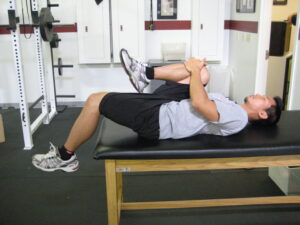
The first muscle I worked on was the rectus femoris – a muscle that extends the knee and flexes the hip. I have previously tested this muscle to be short with the Modified Thomas Test.


This is what my Thomas Test looked like. My leg now comes down to the table. 

The Postural Restoration Institute tells us that posture affects muscle tone and breathing affects posture. In fact, the diaphragm is important for posture and motor control as well as for breathing (Courtney, 2009). Breathing drills alone have improved my flexibility. So, I would start every session with deep diaphragmatic breathing with my spine in a neutral position for 5-10 breaths.

This drill is effective for reducing anterior pelvic tilt.

Next I alternated between foam rolling and stretching. We don’t know why foam rolling – or massage therapy for that matter – works, but it does. Interestingly, we now know that stretching doesn’t increase the length of the muscle but rather improves flexibility by modifying sensation (Weppler and Magnusson, 2010). According to a recent study by Mohr and Colleagues (2014) combining stretching and foam rolling has an additive effect on flexibility. I foam rolled the muscle for 60sec and then stretched it for 60sec performing each for three rounds.

The third part of the session involved a technique called proprioceptive neuromuscular facilitation or PNF for short. From a stretched position I contracted the stretched muscle for 5sec, relaxed, moved into the newfound range of motion, and repeated until I couldn’t comfortably stretch any farther. At that point I contracted the muscle’s antagonists: the gluteus maximus and hamstrings.

Finally, I concluded the session by performing a strength exercise for the glutes into the new range of motion. I performed 10 glute bridges. Developing strength and control in end-range positions is necessary to maintain flexibility and prevent injuries. The combination of these four techniques has given me normal hip extension range of motion. Following this experiment, I was able to restore shoulder flexion.


Improving flexibility can help or hurt an individual in terms of athletic performance and injury prevention. When increased flexibility is needed, it may be necessary to combine a variety of protocols and it’s important to be able to control this newfound range of motion.

Stay fit,

Jonathan Pratt

Monday, 3 November 2014

The Black Hole of Training

One of my favourite training quotes for running is, “Make your hard days hard and your easy days easy.” I think the individual who came up with this quote was 1972 Olympic marathon champion Frank Shorter. Shorter often complained that he couldn’t find any training partners who wanted to run slow enough on easy runs, but then were unable to stick with him on the hard days.

Frank Shorter finishing the 1972 Olympics in Munich. Shorter averaged 140 miles/week for the entire 1970s.

            Recently I watched a seminar with exercise physiologist Stephen Seiler. I’ve been a big fan of Seiler over the last year, because he not only studies endurance training, but also studies what elite endurance athletes do for training. He found that elite athletes across all endurance sports spend at least 75-80% of their training at very low intensities (55-75% of maximum heart rate). Another 5% of training is spent at 75-85% max HR and the remaining 15-20% is performed at greater than 85% max HR.
            Contrast this with sub-elite and recreational runners. According to Seiler, both groups tend to spend much more time training at 75-85% max heart rate. Seiler calls this the “black hole” of training and it’s usually achieved by running too fast on designated easy days. This type of training ends up being too fast for recovery purposes, yet too slow to develop race specific qualities. The end result is your race specific intervals are too slow, because you tired yourself out the day before.
Running too hard on easy days is a common problem amongst high school and university runners. It’s really hard to force yourself to run at lower than 75% max HR. Hammering easy days would’ve gone by the wayside a long time ago except for the fact that it actually works gets one fit fairly quickly. There is a downside though! Back in the 1980s when Portugal was one of the top running nations data was collected on their national level male runners. Those who were doing a lot of sessions at 75-85% max HR (i.e. hammering their easy days) had fewer years at the national level than those who spent more time at lower intensities. As well, this group wasn’t quite as fast as the other group.
             If you’ve spent enough time studying the training of elite runners you might ask about Hicham el Guerrouj. He often dropped down to 3:00-3:10/km on his easy days and occasionally 2:50/km. However, as fast as this seems the world record pace for the marathon is 2:55/km. So, relatively speaking he wasn’t running that fast. Keep in mind too that El G had better running genetics than just about anyone that ever lived, was running 70-100 miles/week, and didn’t have school/work interfering with his recovery. Late in his career it would’ve been necessary to go a little faster in order to see continued gains, but as interval training intensified and the competitive season approached he ran slower on his easy runs.

Benefits of Running Slowly

            According to running coach John Kellogg, running at low intensities allows one to run without straining. The best athletes in every sport always make things look effortless. By learning how to run without straining you become more economical. Seiler also believes that low intensity running is the key to improving economy as it allows one to practice the skill of running for longer. There are also cardiovascular benefits that develop better at low intensities. In Ultimate MMA Conditioning Joel Jamieson says that at high heart rates the heart contracts before it fully fills. Thus, training at lower heart rates allows the heart’s left ventricle to expend thereby improving the pumping capacity of the heart. Finally, higher intensity interval training turns up our fight-or-flight mechanism, which releases a lot of stress hormones. By going very slow the next day we turn up our rest-and-digest system thereby aiding in recovery, but still allowing for increased running adaptations.

            In conclusion, one can improve running ability through a variety of ways. However, in order for most runners to maximize running performance and have a longer career it’s best to spend most of one’s time training at very low intensities with about 15-20% of training at higher intensities. 

Stay fit,

Jonathan Pratt

Monday, 7 July 2014

The Value of Keeping a Training Log

           When I was 15 I received my first training log for runners. It had training tips, pace charts, comparison charts, and a place to graph your weekly mileage. Being a fan of details I recorded everything including the people who ran with me as well as the animals I saw on my runs. Over the years I’ve gotten away from recording much of my training to my detriment. It can be as simple as writing the sets and reps of a strength workout or km run in a notebook to an online training log.

My first training log

            The first benefit of a keeping a training log is to track progress. Sometimes you have some terrible workouts and it can get you down, but then you look at your training log and get to see just how far you’ve come. Also, if your progress comes to a halt your log might indicate why. Maybe you’ve missed a lot of workouts or you’ve been doing the same program for too long (or you switch programs too often).
Another benefit of the training log is that it allows others to give you feedback on your training. One time a friend of mine felt he was in good shape, but he wasn’t doing as well in races as he would’ve liked. After examining his training logs I could see he was doing a lot of things right; he was running solid weekly mileage, tempos, and race pace intervals. However, he was getting next to no training at faster than race pace. Considering that it was the end of the season and speed work was his strength I suggested a few workouts at much faster than race pace. It was an instant breakthrough. In addition, a coach or physiotherapist might be able to determine why you were injured. Maybe you progressed volume too quickly, made a sudden change in intensity or terrain, or changed shoes recently. Recording the date you bought your shoes can be helpful in this regard.
            You may also find a training log useful for accountability. It sucks to see a bunch of blank spaces where you skipped workouts.
            I think the most important benefit of keeping a training log though is that it provides one with accurate information about past training which can be used for future training. I have a pretty good memory, but over time performances become inflated. For instance, a common workout I used to perform for cross-country season was 6x1km (60-90sec) rest. After a layoff I came back and was disappointed that I was running my intervals 10sec too slow. The problem wasn’t that I was running too slow, but rather that I was remembering my all-time best performance as the usual. My training log revealed that I was right on schedule.

            Training logs offer the ability to track progress, receive feedback from others, hold one accountable, and provide accurate information about past training.

Stay fit,

Jonathan Pratt